
Divorce Law in India: Grounds, Procedure, Maintenance…
Important Disclaimer This article is provided solely for general legal information and public awareness. It…
EXCELLENT Based on 66 reviews
 Posted on Google
 Nabeel AkhtarFacing a criminal case can be stressful, but Advocate Nikhil Rathod made the entire process manageable. His strategic approach and strong representation gave me great relief.Posted on Google
 Srinath KarliAn experienced and sharp lawyer. Truly fast and great precise advocacy services offered. Highly recommended! Thankyou.Posted on Google
 SHIVA GAIKWAD
Trustindex verifies that the original source of the review is Google.
Good experience 👍👍👍👍Posted on Google Mangesh LawandeBest advocate for getting justice in Pune he is a very kind by nature 😊✨💫
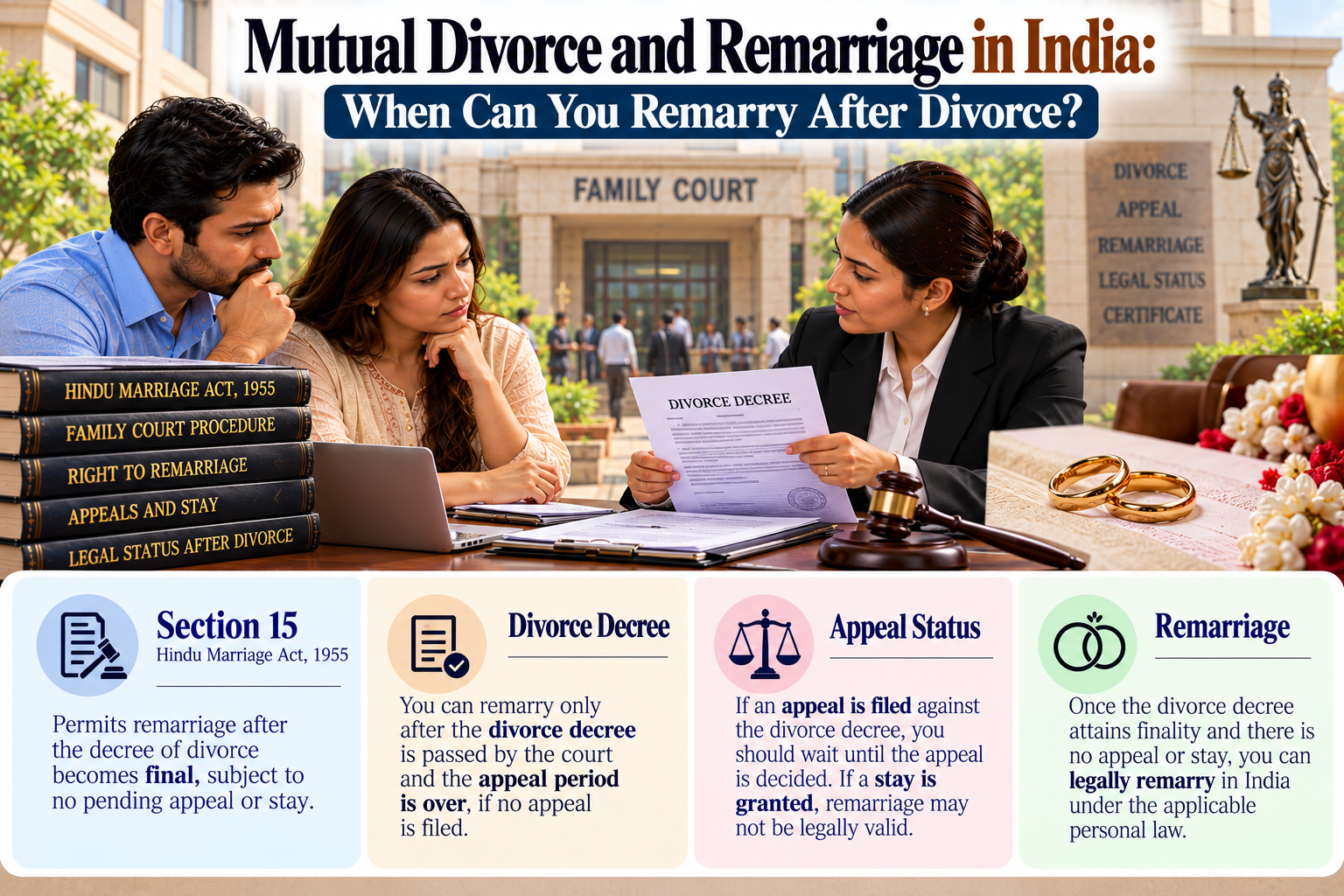
Divorce does not automatically mean that a person can immediately enter into another marriage. For a person who has obtained a mutual consent divorce in Pune or elsewhere in India, the timing of remarriage depends on the legal status of the divorce decree and the right of appeal.
Under the Hindu Marriage Act, 1955, Section 15 specifically deals with when a divorced person may marry again. The provision is important because a divorce decree may have been passed, but the period for challenging that decree may still be relevant. A person planning a second marriage should therefore verify that the earlier marriage has been legally dissolved and that the conditions for remarriage are satisfied.
Section 15 provides that where a marriage has been dissolved by a decree of divorce, either party may marry again when there is no right of appeal against the decree, when the time for filing an appeal has expired without an appeal being presented, or when an appeal has been presented but has been dismissed.
The provision is therefore concerned with the finality of the divorce decree. The fact that both spouses obtained divorce by consent does not by itself mean that every procedural issue connected with the decree can be ignored.
A person should not assume that the date on the divorce decree automatically becomes the date from which remarriage is risk-free. The first question is whether any appeal lies against the decree and, if so, whether the applicable period for filing an appeal has expired or an appeal has already been dismissed.
In a mutual consent divorce, the procedural position may differ from a contested divorce because the Family Courts Act restricts appeals from certain orders passed with the consent of the parties. Even so, the exact wording and nature of the order should be checked before a second marriage is solemnized.
Mutual consent divorce generally proceeds under Section 13B of the Hindu Marriage Act. Once the court passes the decree dissolving the marriage, the parties cease to be spouses from the legal standpoint. However, the question of remarriage must still be examined with reference to Section 15 and the nature of the decree.
Where the decree is a genuine consent decree and there is no appeal available against it under the applicable law, the legal position can be different from a contested divorce decree against which an appeal may be filed. The parties should retain the certified copy of the decree and verify the appellate position before fixing a marriage date.
There is no present requirement under Section 15 of the Hindu Marriage Act that a divorced person must wait for one year after the divorce decree before marrying again. The earlier proviso that imposed a one-year restriction was repealed in 1976.
The important issue today is not an automatic one-year waiting period. Instead, the person must consider whether the decree has become legally capable of supporting remarriage under Section 15, including the position regarding appeal.
The Supreme Court has considered the relationship between Section 15 and a pending appeal. In N. Rajendran v. S. Valli, decided on 3 February 2022, the Court examined a situation in which a person remarried after obtaining a divorce decree but an appeal against that decree was subsequently filed. The Court explained that Section 15 does not make the right to remarry arise merely because a particular number of days has passed from the decree. Where a right of appeal exists, the relevant appeal period and the filing of an appeal have to be considered.
The Supreme Court also considered the effect of the time required for obtaining a certified copy and the statutory appellate period. The decision demonstrates why relying only on an assumed 30-day or other fixed waiting period can be unsafe. The applicable court, statute and procedural circumstances have to be examined.
The Supreme Court has also explained that Section 15 is primarily concerned with protecting the position of a person who may challenge a decree of divorce. In Anurag Mittal v. Shaily Mishra Mittal, the Court considered Section 15 in the context of remarriage during the appellate stage and explained that a marriage entered into contrary to Section 15 does not automatically become void merely because the statutory conditions for remarriage were not satisfied at that moment.
This does not mean that a person should deliberately marry during an appeal. A pending appeal can create serious litigation and uncertainty concerning the parties’ rights. The prudent legal approach is to verify the appellate status and avoid treating the absence of an interim stay as equivalent to complete procedural finality.
Where the decree has been passed and the relevant appeal period has expired without an appeal, Section 15 permits remarriage subject to the other legal requirements applicable to the proposed marriage.
For practical purposes, a person should preserve the decree, check the date from which the appeal period is calculated, confirm whether an appeal or connected proceeding has been filed, and obtain appropriate court records where necessary.
This is one of the most important risks to examine. A person should not decide that an appeal will probably not be filed merely because the former spouse has expressed no intention to challenge the decree.
The safer approach is to establish the appellate position before solemnizing the second marriage. If an appeal has already been filed, the person should obtain the relevant order and understand whether any stay or other direction affects the divorce decree.
A settlement agreement can resolve financial, property, custody, maintenance and other matrimonial issues, but the settlement itself is not the same thing as the divorce decree. A settlement may contain terms concerning future claims or implementation of payments, but the legal status of the marriage changes through the decree of divorce.
Accordingly, a person should not treat the signing of a settlement agreement, filing of a joint petition, first motion, or second motion as equivalent to the final dissolution of marriage. The relevant date for remarriage is connected to the legally operative divorce decree and the conditions under Section 15.
A pending financial obligation under a settlement does not necessarily mean that the marriage continues. The effect depends on the wording of the settlement and the divorce decree. A decree may dissolve the marriage while payment obligations continue to be performed in accordance with the settlement.
Before remarriage, however, a person should understand whether any application, undertaking, stay order or enforcement proceeding connected with the divorce case could affect the circumstances. Financial settlement obligations and marital status are separate legal questions.
Obtaining the certified copy is an important practical step even where the judgment has already been pronounced. The decree is the primary document demonstrating dissolution of the earlier marriage.
Before registering or solemnizing a second marriage, it is advisable to have the final decree available and to verify the appellate position. Documentary proof is particularly important where the second marriage is to be registered, where the parties have different residences, or where immigration, employment, inheritance or other records may later require proof of marital status.
Yes, a divorced person can remarry in Pune after the earlier marriage has been legally dissolved and the requirements governing remarriage are satisfied. The place of the second marriage does not by itself change the conditions under the applicable personal law.
If the earlier divorce was granted by a Pune Family Court, the certified decree and appellate status should be checked. If the decree was passed in another district or State, the same documents and appellate position may need to be examined before a second marriage is solemnized in Pune.
The Hindu Marriage Act is not the governing statute for every marriage. If the earlier marriage was solemnized under the Special Marriage Act, 1954, the relevant provisions of that Act must be examined. The remarriage provisions under the applicable statute should therefore be identified from the record of the earlier marriage and divorce.
This distinction is particularly important for interfaith couples and couples whose marriage was registered under the Special Marriage Act. The fact that the divorce was obtained in a Family Court does not, by itself, determine which personal-law statute governs remarriage.
Residence outside India does not remove the need to establish the legal dissolution of the earlier marriage. An NRI planning to remarry should keep the Indian divorce decree and verify whether any appeal is pending.
Where the second marriage is intended to be registered outside India, foreign authorities may require additional documentation, translations, apostille or other formalities. Those requirements are separate from the Indian-law question of when remarriage becomes lawful.
Remarriage does not automatically terminate parental rights or a child’s entitlement to support. If the earlier mutual divorce included custody, visitation, education, medical-expense or child-support arrangements, those terms should continue to be followed unless they are lawfully modified.
A second marriage should therefore not be treated as cancelling obligations owed to children from the first marriage. The financial and parenting arrangements contained in the divorce settlement should be reviewed separately.
Similarly, remarriage does not automatically erase contractual or court-recognised settlement obligations relating to property, alimony, maintenance, stridhan or other financial matters. A person should examine the final settlement and decree before assuming that all obligations ended when the divorce became final.
Before fixing or solemnizing a second marriage, the following sequence can help identify the main legal issues:
| Issue | What it means |
|---|---|
| First motion | Beginning of the mutual-consent divorce process; marriage is not dissolved merely because first motion is recorded. |
| Settlement agreement | Records agreed terms between spouses; it is not by itself a divorce decree. |
| Second motion | Final stage of the Section 13B process before the decree is passed. |
| Divorce decree | Judicial order dissolving the marriage. |
| Section 15 | Governs when a divorced person may marry again under the Hindu Marriage Act. |
| Appeal status | Relevant to determining whether the conditions for remarriage have been satisfied. |
| Second marriage | Requires compliance with the applicable personal law and registration requirements in addition to the earlier divorce being legally sufficient. |
Not necessarily. The divorce decree and the applicable appellate position should be checked under Section 15 of the Hindu Marriage Act before remarriage.
No automatic one-year post-decree waiting period presently applies under Section 15 of the Hindu Marriage Act. The focus is on the decree and the applicable right and period of appeal.
The six-month period under Section 13B concerns the mutual divorce process. It should not be confused with the separate legal requirements governing remarriage after the decree.
If the applicable appeal period has expired and no appeal has been presented, Section 15 may permit remarriage. The exact appellate provision and dates should still be verified.
A pending appeal can create legal and practical complications. The appellate order and the effect of Section 15 should be examined before taking any step toward remarriage.
A settlement agreement is not itself a divorce decree. The marriage must have been legally dissolved and the conditions governing remarriage must be satisfied.
No. A parent’s obligations toward a child from the earlier marriage are not automatically cancelled by a second marriage.
Not automatically. The effect depends on the decree and settlement terms, including whether any payment or other obligation remains outstanding.
Generally, the place of the second marriage does not change the legal conditions for remarriage. The earlier decree and its appellate status should be verified.
The certified divorce decree and relevant records concerning the appellate status should be retained, along with documents required for the new marriage.
Section 15 is a provision of the Hindu Marriage Act. If the earlier marriage was governed by another statute, the corresponding provisions of that statute must be examined.
The possibility of an appeal depends on the applicable law, limitation period and procedural circumstances. Remarriage should therefore not be planned on the assumption that an appeal cannot be filed.
The decree is an important document, but the marriage-registration authority may require additional identity, address and other documents under the applicable rules.
An NRI may remarry after the Indian marriage has been legally dissolved and the requirements for remarriage are satisfied. Foreign registration requirements may additionally apply.
Remarriage does not by itself cancel an existing custody or visitation arrangement. The terms of the relevant order or settlement continue to require attention unless lawfully modified.
Mutual divorce and remarriage are legally connected but distinct stages. Obtaining a Section 13B decree is the first essential step, but a person planning to remarry should also examine the requirements of Section 15, the applicable appeal provisions and the actual status of any appeal.
The safest approach is to rely on the final divorce decree and verified court records rather than an assumed waiting period. The settlement, child-related obligations, maintenance arrangements and property commitments should also be reviewed separately before a second marriage is solemnized.
This article is provided solely for general legal information and public awareness. It is not legal advice, legal opinion, or a legal solution to any specific facts or circumstances. Laws and their interpretation may change, and the application of law depends upon the facts of each individual matter. Readers should not rely upon this article as a substitute for obtaining appropriate legal advice concerning their specific circumstances. Nothing contained in this article creates, establishes or constitutes an advocate-client relationship between the reader and Trident Legal Services, Advocate Nikhil Rathod, or any other person associated with the publication.
+91 820 890 9423
desk@tridentlegal.in
Flat No. 302, Kalunkhe Niwas, Khopade Nagar, Gujaewadi, Katraj, Pune - 411041


I was really impressed with Trident Legal and Advocate Nikhil Rathod. Even though they just started,
Trident Legal and Advocate Nikhil Rathod are really good at what they do. Even though they
I had a great experience with Trident Legal and Advocate Nikhil Rathod. Even though they are
Trident Legal, with Advocate Nikhil Rathod, is like a rising star in the legal world. I
I was lucky to work with Trident Legal and Advocate Nikhil Rathod. Even though they just
Trident Legal and Advocate Nikhil Rathod are really amazing! They helped me with legal stuff and
Trident Legal and Advocate Nikhil Rathod are like superheroes! They are really good at legal stuff
I wasn’t sure about Trident Legal because they are new, but they surprised me! Advocate Nikhil
I had the honor of working with Trident Legal and Advocate Nikhil Rathod. They were really
Trident Legal, led by Advocate Nikhil Rathod, is like a superhero in the legal world. Even

Important Disclaimer This article is provided solely for general legal information and public awareness. It…
When spouses decide to seek divorce by mutual consent, arrangements for their children often require…
When a marriage involves an Indian citizen, an Overseas Citizen of India (OCI) cardholder or…
Indian couples living or working abroad sometimes obtain a divorce decree from a foreign court…
When parents agree to a mutual divorce, arrangements for their minor child may extend beyond…
Spouses may hold assets in more than one country. A couple filing for mutual divorce…
