
Mutual Divorce and Living Separately in Pune: How Long Must Husband and Wife Live Apart?
Legal information and public awareness • Mutual divorce in Pune
Article Overview
Key points in this article
- Section 13B separation requirement
- Meaning of “living separately”
- Same-household and different-city situations
- Reconciliation and continued consent
- Documents and practical checklist
- Cooling-off period and recent legal position
The article below retains the full text, FAQs and disclaimer.
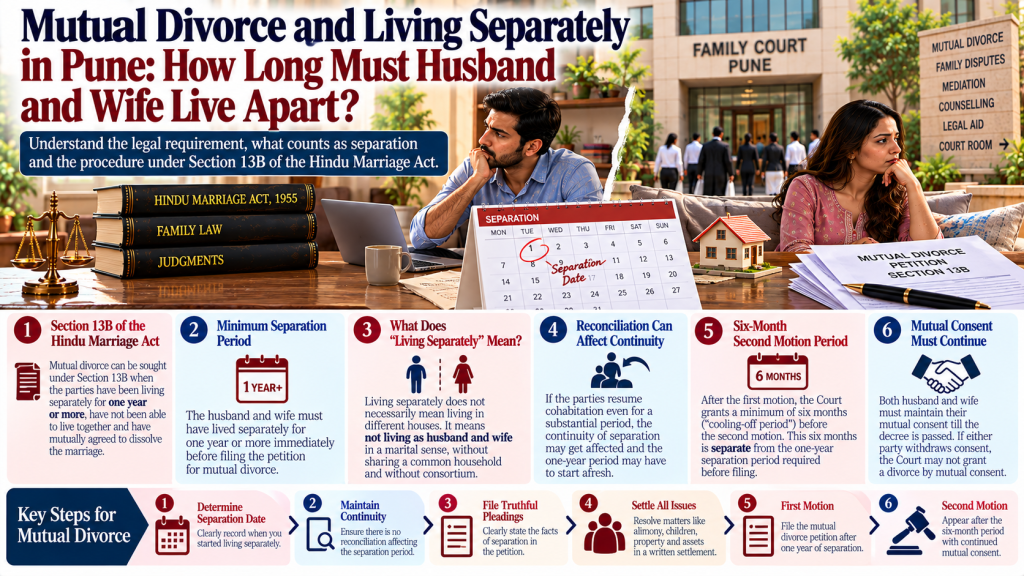
One of the most common questions about divorce by mutual consent is whether husband and wife must actually live in different houses for one year before they can file. The answer requires a closer reading of Section 13B of the Hindu Marriage Act, 1955 and the Supreme Court’s interpretation of the expression “living separately”.
For a Hindu marriage governed by the Hindu Marriage Act, Section 13B(1) requires the spouses to jointly present a petition stating, among other things, that they have been living separately for a period of one year or more, have not been able to live together, and have mutually agreed that the marriage should be dissolved. The law therefore focuses on the statutory conditions rather than merely counting the number of days since the spouses stopped residing at one address.
What does “living separately” mean for mutual divorce?
- 1 What does “living separately” mean for mutual divorce?
- 2 Is one year of living separately compulsory?
- 3 Does the one-year period have to be immediately before filing?
- 4 What if the spouses live in the same house?
- 5 What if one spouse moved to another city?
- 6 What if the spouses separated several years ago?
- 7 Does separation mean that the marriage is automatically dissolved?
- 8 What is the difference between separation and divorce?
- 9 What if the parties reconcile during the one-year period?
- 10 What if the spouses reconcile after filing the mutual divorce petition?
- 11 Does filing a mutual divorce petition prove that the spouses have been living separately?
- 12 What documents can show a period of separation?
- 13 Can a husband and wife live separately but continue to communicate?
- 14 Can the spouses continue to share expenses during separation?
- 15 What if there is a child?
- 16 Does living separately affect maintenance?
- 17 Can mutual divorce be filed before one year of separation?
- 18 Does the six-month cooling-off period start from the date of separation?
- 19 Can the six-month period be waived?
- 20 How should the separation date be stated in a Pune mutual divorce petition?
- 21 What mistakes should be avoided?
- 22 Practical checklist before filing mutual divorce
- 23 Recent Supreme Court position
- 24 Conclusion
- 25 Frequently Asked Questions
- 26 Important Disclaimer
The expression has a specific legal meaning. The Supreme Court has explained that “living separately” does not necessarily mean that the spouses must occupy different physical residences. The relevant consideration is whether they are no longer living together as husband and wife and whether the marital relationship has effectively ceased in the manner contemplated by Section 13B.
Accordingly, spouses may in appropriate circumstances live under the same roof because of financial, family, housing or other practical constraints and still contend that they have been living separately in the legal sense. Conversely, merely having different addresses is not by itself sufficient if the parties continue to live as husband and wife.
This distinction is important when preparing a mutual-consent petition because the pleading should accurately describe the actual circumstances instead of mechanically stating that the parties have lived at different addresses.
Is one year of living separately compulsory?
For a petition under Section 13B(1) of the Hindu Marriage Act before the competent Family Court or District Court, the statutory requirement is that the parties have been living separately for one year or more, have not been able to live together, and have mutually agreed to dissolve the marriage.
The one-year requirement relates to the condition for presentation of the mutual-consent petition. It should not be confused with the separate six-month period ordinarily associated with the second motion under Section 13B(2).
In other words, there are two different time concepts:
- the parties must satisfy the one-year separation requirement for presentation of the petition under Section 13B(1); and
- after presentation of the petition, the second motion ordinarily cannot be made earlier than six months, subject to the legal position regarding waiver of that period.
Does the one-year period have to be immediately before filing?
The Supreme Court’s interpretation of Section 13B has emphasised that the parties should have been living separately for the required period immediately preceding the presentation of the petition. The factual narrative should therefore establish continuity of the relevant separation period rather than merely showing that the spouses separated at some point in the distant past.
For example, if the spouses separated in January 2025 and continued living separately as contemplated by Section 13B, a petition filed after January 2026 may satisfy the one-year period, subject to the other statutory requirements. If they resumed marital life for a meaningful period in between, the factual position needs to be examined rather than simply adding together every period during which they occupied different residences.
What if the spouses live in the same house?
Living in the same house does not automatically prevent a petition under Section 13B. The Supreme Court’s interpretation of “living separately” focuses on the marital relationship rather than only the physical location.
However, this does not mean that every couple occupying separate bedrooms automatically satisfies Section 13B. The court may examine the circumstances and the parties’ statements to determine whether they have genuinely ceased to live together as husband and wife.
Where the parties continue to share a household because of children, financial limitations, family circumstances or lack of alternative accommodation, the petition should accurately explain the circumstances. The objective is not to manufacture a period of separation but to place the true facts before the court.
What if one spouse moved to another city?
If one spouse moved from Pune to another city and the parties thereafter stopped living together as husband and wife, the change of residence may provide evidence supporting the separation period. Useful material may include address records, employment records, rent agreements, correspondence, travel records or other documents, depending upon the circumstances.
However, physical distance alone is not the legal test. The parties must also satisfy the other requirements of Section 13B, including the mutual agreement to dissolve the marriage and the assertion that they have not been able to live together.
What if the spouses separated several years ago?
A long period of separation can make the factual history easier to establish, but the court still needs to be satisfied about the statutory requirements and the genuineness of the parties’ consent.
Recent Supreme Court orders continue to record cases in which spouses had been living separately for several years before approaching the Court for a mutual-consent divorce. In a July 2025 proceeding, for example, both parties informed the Supreme Court that they had been living separately for more than ten years and proposed to proceed under Section 13B. Such cases illustrate the relevance of the separation history, but each case remains dependent on its own facts and procedural route.
Does separation mean that the marriage is automatically dissolved?
No. Living separately for one year does not itself dissolve the marriage.
Section 13B requires a joint petition and further judicial proceedings. The parties must continue to satisfy the applicable requirements, and the court must be satisfied before passing a decree. A couple may have lived apart for many years and still remain legally married until a competent court grants a divorce decree or another legally recognised mode of dissolution applies.
What is the difference between separation and divorce?
Separation describes the parties’ factual and matrimonial circumstances. Divorce is the legal dissolution of the marriage through a decree or another legally recognised process.
A spouse should therefore avoid statements such as “we have been separated for one year, so we are already divorced.” That is incorrect. The one-year separation requirement is one of the conditions relevant to filing a mutual-consent petition under Section 13B(1).
What if the parties reconcile during the one-year period?
If the spouses resume marital life, the factual basis for asserting continuous separation may be affected. A reconciliation should not be concealed merely to satisfy a filing requirement.
The parties should examine the actual duration and nature of the reconciliation and take appropriate legal advice about whether the statutory requirement has subsequently been satisfied. The important issue is the truthfulness of the pleadings and the actual marital relationship.
What if the spouses reconcile after filing the mutual divorce petition?
This is different from reconciliation before filing. Once a mutual-consent petition is filed, consent remains important throughout the process. The Supreme Court has repeatedly held that mutual consent must continue until the decree is passed.
In a significant 2026 Supreme Court judgment concerning a matrimonial settlement, the Court again referred to the principle that consent must subsist not merely when the petition is filed but until the final decree. Therefore, a reconciliation or withdrawal of consent can materially affect the continuation of a Section 13B proceeding.
Does filing a mutual divorce petition prove that the spouses have been living separately?
Not by itself. The petition contains the parties’ pleadings, but the court must still be satisfied about the statutory requirements. The spouses may be questioned or required to make statements regarding the marriage, separation, consent and settlement.
Documents can assist where factual circumstances need to be demonstrated, but the availability of documents does not replace truthful statements and judicial satisfaction.
What documents can show a period of separation?
There is no single mandatory document proving separation in every case. Depending upon the facts, parties may have material such as:
- rent or leave-and-license agreements;
- utility bills or address records;
- employment or transfer documents;
- bank correspondence showing different residential addresses;
- school or child-related records where relevant;
- travel records;
- correspondence between the spouses;
- prior pleadings or court orders referring to separation; and
- other reliable records showing the parties’ actual living arrangements.
The court may not require every item listed above. The appropriate evidence depends on the facts and the court’s directions.
Can a husband and wife live separately but continue to communicate?
Yes. Communication between spouses does not automatically mean that they are living together as husband and wife. They may communicate about children, finances, property, medical matters, family events or pending litigation.
The relevant question is the nature of the matrimonial relationship, not whether the spouses have completely stopped communicating with each other.
Can the spouses continue to share expenses during separation?
Yes. Financial arrangements during separation vary significantly. Spouses may continue to share rent, children’s expenses, loan payments, medical costs or other household obligations while living separately.
Continuing financial interaction does not automatically prevent a finding of separation. The overall circumstances and the actual matrimonial relationship remain relevant.
What if there is a child?
The presence of a child does not prevent mutual divorce. Parents may continue communicating and cooperating for the child’s education, health, residence and other needs even after they have stopped living together as husband and wife.
A mutual divorce settlement should separately address custody, parenting time, education, medical expenses and financial support where applicable. Child-related cooperation should not be confused with continuation of the marital relationship.
Does living separately affect maintenance?
Separation and maintenance are related factual issues but are not identical questions. Depending on the applicable law and the circumstances, a spouse may have maintenance rights or obligations even while the parties are living separately.
Where the parties agree to a mutual divorce, maintenance or permanent alimony should be dealt with clearly in the settlement. If no such agreement exists, the applicable statutory provisions and the facts of the case will determine the relevant claims.
Can mutual divorce be filed before one year of separation?
The ordinary statutory route under Section 13B(1) requires one year or more of living separately before presentation of the mutual-consent petition. This requirement should not be confused with Section 14 of the Hindu Marriage Act, which deals with restrictions on presentation of a divorce petition before one year from the date of marriage and contains an exceptional hardship or depravity provision.
The two provisions address different issues. Section 14 concerns the timing of presentation of a divorce petition after marriage, whereas Section 13B(1) contains the separation requirement for mutual consent.
In exceptional matters before the Supreme Court, Article 142 has also been invoked to grant mutual-consent divorce or waive procedural periods in appropriate circumstances. Such Supreme Court powers should not be treated as an automatic route available before every Family Court.
Does the six-month cooling-off period start from the date of separation?
No. The ordinary six-month period under Section 13B(2) is calculated from the date of presentation of the mutual-consent petition, not from the date on which the spouses began living separately.
This distinction is important. If spouses have lived separately for three years before filing, the six-month period under Section 13B(2) does not ordinarily disappear merely because the separation is already lengthy. The court may consider waiver of the cooling-off period where the legal requirements and applicable judicial principles are satisfied.
Can the six-month period be waived?
The Supreme Court has held that the six-month period under Section 13B(2) can, in appropriate cases, be waived by the competent court when the circumstances justify such relief. The power is discretionary and depends upon the facts and the requirements of the law.
A recent Supreme Court order dated 27 May 2026 recorded a mutual-consent divorce after the Court waived the six-month cooling period in the facts and circumstances of that case. This illustrates that the cooling-off period and the one-year separation requirement are separate concepts.
How should the separation date be stated in a Pune mutual divorce petition?
The petition should state the factual history accurately and consistently. If the parties began living separately on a particular date, the pleadings should explain that date and the circumstances sufficiently to demonstrate compliance with Section 13B.
Where the spouses lived under the same roof but had stopped living as husband and wife, the pleading should not falsely state that they occupied separate residences. Instead, the actual circumstances should be presented in legally appropriate language.
What mistakes should be avoided?
- Using an artificial separation date merely to complete one year.
- Assuming different addresses automatically prove legal separation.
- Ignoring a period of reconciliation.
- Confusing the one-year requirement under Section 13B(1) with the six-month period under Section 13B(2).
- Assuming that one year of separation automatically results in divorce.
- Giving inconsistent dates in pleadings, affidavits and statements.
- Assuming that a private settlement itself dissolves the marriage.
- Assuming that Supreme Court Article 142 orders create an automatic waiver before a Family Court.
Practical checklist before filing mutual divorce
- Identify the date on which the parties stopped living together as husband and wife.
- Check whether the separation has continued for at least one year immediately before filing.
- Consider whether there was any reconciliation or resumption of marital life.
- Identify whether the parties lived in separate residences or under the same roof.
- Collect reasonable documents supporting the factual history where required.
- Confirm that both spouses genuinely consent to divorce.
- Prepare a settlement covering financial and other material claims.
- Address children, property, maintenance and liabilities where applicable.
- Understand the first-motion and second-motion procedure.
- Consider whether waiver of the cooling-off period is legally available on the facts.
- Ensure that all statements made to the court are accurate and consistent.
Recent Supreme Court position
The Supreme Court’s recent matrimonial orders continue to show the importance of separating the statutory requirements from the Court’s exceptional powers. Section 13B remains the ordinary statutory framework for mutual-consent divorce under the Hindu Marriage Act. At the same time, the Supreme Court has in appropriate cases exercised its constitutional power under Article 142 to grant divorce by mutual consent and to deal with procedural periods where the circumstances justify such relief.
In May 2026, the Supreme Court recorded a mutual-consent divorce after waiving the six-month cooling period in the circumstances of that case. The order also recorded the parties’ settlement. This should not be read as eliminating the statutory one-year separation requirement for every Family Court filing. It instead demonstrates the distinction between the statutory process and the Supreme Court’s exceptional constitutional jurisdiction.
The Supreme Court has also reaffirmed in its 2026 matrimonial decisions that mutual consent must continue until the decree. Therefore, a spouse should understand that the separation period establishes only one component of the statutory framework; continued consent and judicial satisfaction remain essential.
Conclusion
For a mutual-consent divorce under Section 13B of the Hindu Marriage Act, the parties ordinarily need to establish that they have been living separately for at least one year immediately before presentation of the petition, have not been able to live together and have mutually agreed to dissolve the marriage.
“Living separately” does not necessarily mean occupying different houses. The Supreme Court has explained that the expression focuses on whether the parties are living as husband and wife. At the same time, the requirement must be established honestly and on the actual facts.
After the petition is filed, the parties must also understand the separate rules governing the second motion, continued consent and the possibility of waiver of the cooling-off period. A long period of separation may make the factual history clearer, but it does not itself dissolve the marriage.
Frequently Asked Questions
1. How long must a couple live separately before filing mutual divorce?
Under Section 13B(1) of the Hindu Marriage Act, the spouses must ordinarily have been living separately for one year or more before presenting the mutual-consent petition.
2. Does living separately mean living in different houses?
Not necessarily. The Supreme Court has interpreted “living separately” as not living together as husband and wife. Physical residence is relevant but is not the only consideration.
3. Can spouses live under the same roof and still file mutual divorce?
In appropriate circumstances, yes. If they are not living as husband and wife despite sharing a residence, the factual circumstances may satisfy the concept of living separately.
4. Does one year of separation automatically grant divorce?
No. The parties must file the appropriate petition and satisfy the remaining statutory requirements before the court can grant a decree.
5. Does the six-month period start from the date of separation?
No. The ordinary six-month period under Section 13B(2) is calculated from the date of presentation of the mutual-consent petition.
6. Can the six-month period be waived?
In appropriate circumstances, the cooling-off period may be waived in accordance with the applicable legal principles and the court’s discretion.
7. What if the parties reconciled during the one-year period?
The effect depends on the nature and duration of the reconciliation. The parties should disclose the true facts rather than artificially calculating a separation period.
8. Can spouses communicate while living separately?
Yes. Communication concerning children, finances, property and other matters does not by itself establish that the parties are living together as husband and wife.
9. Can a couple file mutual divorce if one spouse lives in another city?
Yes, provided the jurisdiction and other statutory requirements are satisfied. The parties should accurately state the circumstances of their separation.
10. Does a long separation prove that consent is still continuing?
No. The length of separation and continuing consent are separate considerations. Both parties must continue to consent to the mutual divorce until the decree.
11. Can a child live with one spouse during the separation?
Yes. Child residence and parenting arrangements can continue during separation and should be addressed separately in the mutual divorce settlement.
12. Does separation itself create a right to permanent alimony?
Not automatically. Maintenance and alimony depend on the applicable law, facts, financial circumstances and any settlement between the parties.
13. Can the parties use the date of a police complaint as the separation date?
A complaint may contain evidence about the matrimonial history, but the separation date should be based on the actual facts rather than simply selecting the date of a complaint.
14. Can the Supreme Court waive the one-year separation requirement?
The Supreme Court has exceptional constitutional powers under Article 142, but such exceptional orders should not be treated as an automatic statutory waiver available in every Family Court matter.
15. What is the most important point about the one-year separation requirement?
The separation period should be genuine, continuous in the legally relevant sense, immediately preceding the petition, and supported by truthful pleadings and statements.
Important Disclaimer
This article is provided solely for general legal information and public awareness. It is not legal advice, legal opinion, or a legal solution to any specific facts or circumstances. Laws and their interpretation may change, and the application of law depends upon the facts of each individual matter. Readers should not rely upon this article as a substitute for obtaining appropriate legal advice concerning their specific circumstances. Nothing contained in this article creates, establishes or constitutes an advocate-client relationship between the reader and Trident Legal Services, Advocate Nikhil Rathod, or any other person associated with the publication.
