Mutual Consent Divorce Lawyer in Pune
Mutual consent divorce is a legal process through which spouses who have mutually decided to end their marriage can jointly ask the competent court for a decree of divorce. A properly prepared petition and a clear settlement can help the parties understand their obligations, address unresolved issues and follow the court procedure in an orderly manner.
This page provides general information about mutual consent divorce, the applicable legal framework, documentation, settlement terms and the usual stages of proceedings in Pune. The applicable law and procedure may differ depending on the parties’ religion, the law under which their marriage was solemnised and the facts of the case.
What Is Divorce by Mutual Consent?
For marriages governed by the Hindu Marriage Act, 1955, Section 13B provides for divorce by mutual consent. Under Section 13B(1), the spouses may jointly present a petition where they have been living separately for one year or more, have not been able to live together and have mutually agreed that the marriage should be dissolved.
“Living separately” is assessed in its legal context and does not necessarily mean that the parties must have lived at different addresses in every situation. Whether the statutory conditions are satisfied depends on the evidence and circumstances of the particular case.
Who May Consider a Mutual Consent Divorce?
This procedure may be relevant where both spouses freely agree that the marriage should end and are able to make informed decisions about the practical consequences of separation. The parties should consider whether they have reached a genuine understanding about matters such as:
- Permanent alimony, maintenance or other financial arrangements.
- Custody, parenting arrangements, visitation and child-related expenses, where children are involved.
- Return or division of belongings, jewellery, documents and other property-related issues.
- Pending matrimonial, maintenance, domestic violence or other proceedings and the lawful steps, if any, agreed for their resolution.
- Any other terms necessary to record the parties’ settlement clearly and accurately.
Consent must be voluntary and must continue as required by law. Neither spouse should be pressured into signing a settlement or giving consent.
Legal Process for Mutual Consent Divorce in Pune
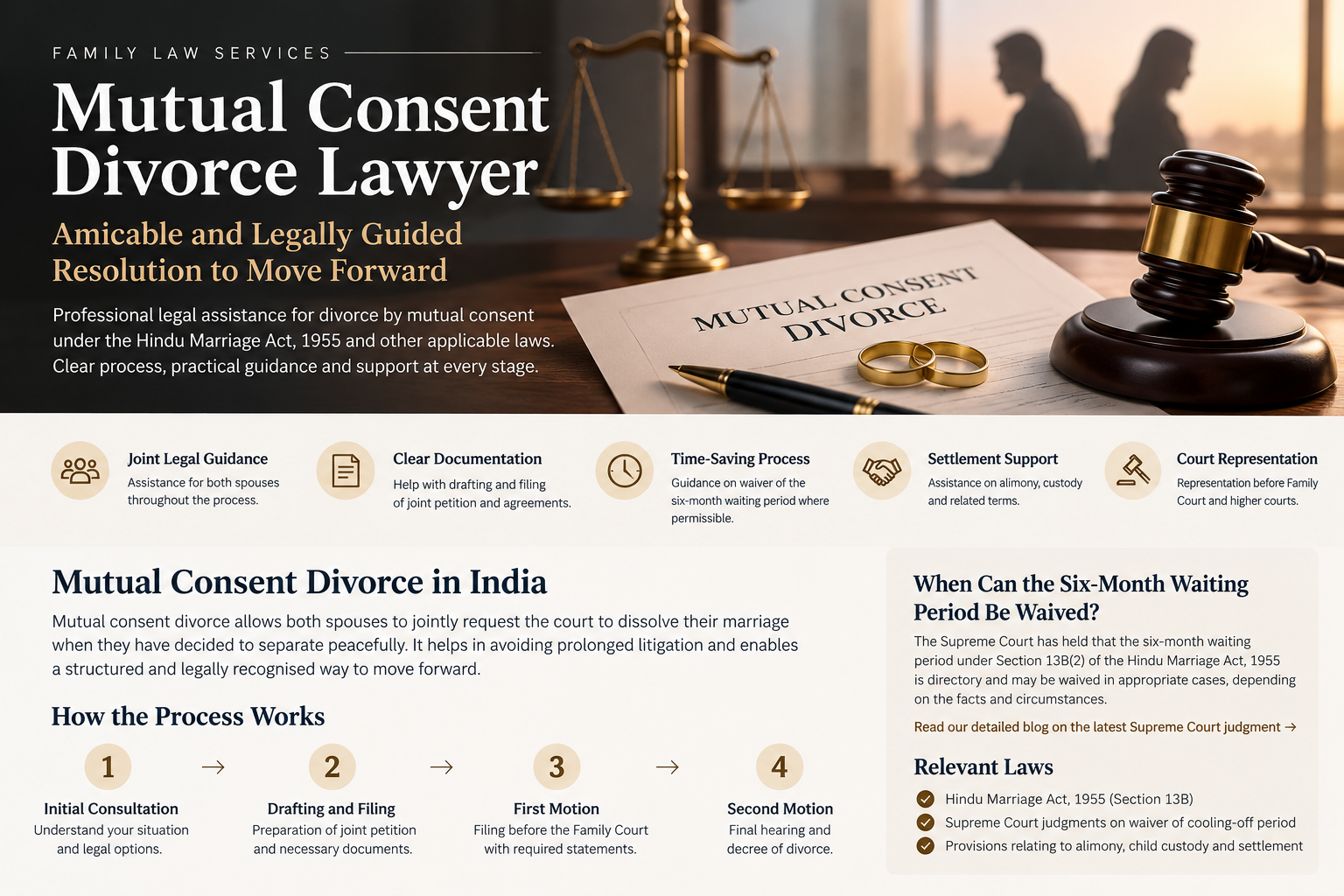
1. Initial review and settlement discussions
The parties should first identify the law applicable to their marriage, confirm the relevant dates and discuss the issues that need to be resolved. A written settlement can help reduce ambiguity, but its terms should be understood by both spouses before they sign it.
2. Preparation and filing of the joint petition
Where the statutory conditions are met, a joint petition is prepared with the necessary facts, statements and supporting documents and filed before the competent court. Jurisdiction depends on the applicable legal provisions and the parties’ circumstances; the appropriate court should be determined before filing.
3. First motion
The court considers the joint petition and the statements of the parties in accordance with the applicable procedure. The court may ask questions to satisfy itself that the parties understand the process and that their consent is genuine.
4. Cooling-off period and second motion
Section 13B(2) of the Hindu Marriage Act generally contemplates a second motion not earlier than six months after presentation of the petition and within eighteen months of that date. The court must be satisfied that the parties’ consent continues and that the legal requirements for a decree have been fulfilled.
5. Decree of divorce
If the court is satisfied that the statutory requirements are met, it may pass a decree dissolving the marriage. The marriage is not dissolved merely because the parties have signed a settlement or filed a joint petition; the court’s decree is required.
Can the Six-Month Waiting Period Be Waived?
The six-month period is commonly referred to as the cooling-off period. In Amardeep Singh v. Harveen Kaur, (2017) 8 SCC 746, the Supreme Court held that the period under Section 13B(2) is directory and may be waived in appropriate cases. Later decisions, including Amit Kumar v. Suman Beniwal, (2023) 17 SCC 648, explain that the relevant considerations are not to be applied as a rigid checklist in every matter.
A court may consider, among other circumstances, the duration of separation, whether reconciliation efforts have failed, whether the parties have genuinely settled outstanding issues and whether requiring further waiting would serve a useful purpose. Waiver is not automatic simply because both parties request it; the court must exercise its discretion on the facts and applicable law.
The Supreme Court’s power under Article 142 of the Constitution is a separate constitutional power available to the Supreme Court in matters before it. It should not be confused with the statutory discretion exercised by a Family Court when considering waiver under Section 13B(2).
Documents Commonly Required
The exact documents depend on the case and the court’s requirements. Commonly relevant records may include:
- Marriage certificate or other available proof of marriage.
- Identity and address proof of both spouses.
- Photographs or other documents relevant to the marriage, where required.
- Details supporting the period of separation and the circumstances relevant to jurisdiction.
- Written settlement or memorandum of understanding, if the parties have entered into one.
- Details and copies of relevant orders or filings in pending cases, if any.
- Financial information and child-related details where maintenance, alimony or parenting arrangements are involved.
This is a general checklist, not an exhaustive list. Additional documents or affidavits may be necessary depending on the facts and applicable procedure.
How Long Does the Process Take?
The time required depends on the court’s schedule, the completeness of the documents, the parties’ availability, the nature of the settlement and whether any application for waiver of the cooling-off period is made and allowed. Where the statutory waiting period is not waived, the second motion is ordinarily subject to the timing prescribed by Section 13B(2). No particular timeline or outcome can be guaranteed.
What Is the Cost of a Mutual Consent Divorce?
There is no single total cost applicable to every matter. Expenses may depend on court fees, document preparation, the complexity of the settlement, the number of hearings, any related proceedings and the professional fee arrangement agreed with the lawyer. Parties should seek a clear explanation of the likely components of cost for their particular circumstances rather than relying on a general estimate as a guaranteed amount.
Why Careful Settlement Drafting Matters
A settlement should be clear, specific and consistent with law. Broad or uncertain wording about maintenance, child arrangements, property or pending cases can create disagreements later. The parties should understand which obligations are immediate, which depend on a future event and what steps are required to implement each term. Arrangements concerning children should be framed with their welfare and the court’s legal obligations in mind.
Frequently Asked Questions
Can one spouse file a mutual consent divorce petition alone?
Mutual consent proceedings require a joint petition and the legally required consent of both spouses. If one spouse does not agree, the mutual consent procedure may not be available, and the legal options would need to be assessed separately.
Is one year of separation always required?
Section 13B(1) of the Hindu Marriage Act specifies one year or more of living separately. Whether the condition is met and whether any exceptional legal issue arises must be assessed on the facts; parties should not assume the requirement can simply be ignored.
Can the six-month period always be waived?
No. Waiver is a matter of judicial discretion. The court considers the circumstances and applicable precedent, and a request for waiver does not guarantee that it will be granted.
What happens if one spouse withdraws consent?
Mutual consent must continue as required by law. If consent is withdrawn or disputed, the court will consider the legal consequences in light of the stage of proceedings and applicable precedent. The other spouse cannot assume that the decree will automatically be granted.
Can child custody and maintenance be included in the settlement?
The parties may record agreed arrangements concerning maintenance, child-related expenses, custody and visitation, subject to the applicable law and the court’s duty to consider the welfare of the child. An agreement cannot override statutory requirements or the court’s legal responsibilities.
Does filing the petition itself end the marriage?
No. The marriage is dissolved by the decree of divorce passed by the competent court, not merely by filing the petition or signing a settlement.
Informational Disclaimer
This page is for general informational and educational purposes only and does not constitute legal advice, a legal opinion or a guarantee of outcome. The law and procedure applicable to a particular marriage may depend on the governing statute, facts, jurisdiction and current judicial decisions. Obtain advice based on the complete facts and documents before taking legal steps.
Google Reviews
Read feedback shared by clients about their experience with Trident Legal Services.


Apply Now – Mutual Consent Divorce Consultation
Send your details using the form below to enquire about legal assistance for mutual consent divorce in Pune.