Claiming prior use of a trademark can materially affect an application, examination, opposition or infringement dispute. A prior-use claim should be accurate, consistent and supported by documentary evidence. Merely stating an old date of use is not enough: the applicant must be able to substantiate when, by whom and in relation to which goods or services the mark was used.
1. What does “prior use” mean in trademark filing?
Prior use refers to commercial use of a trademark before the filing date of the application, as claimed by the applicant. In a trademark application, the applicant may claim that the mark has been used from a particular date or may state that it is proposed to be used. A claimed use date should correspond to the applicant’s genuine commercial history and the goods or services identified in the application.
Prior use may become relevant when assessing distinctiveness, conflicts, opposition proceedings or statutory protection for earlier users. The legal significance of the evidence depends on the issue being examined and the facts—not simply the age of a document.
2. Rule 25 of the Trade Marks Rules, 2017
Rule 25 deals with the statement of user in applications. Where use is claimed before the application date, Rule 25(2) requires an affidavit testifying to that use along with supporting documents. The affidavit should clearly set out the relevant period and the person who used the mark, and should align with the goods or services claimed.
Applicants should read the rule together with the application requirements and the Trade Marks Act, 1999. The prescribed user claim and evidence should not be treated as a formality or populated with an unverified date.
3. Which documents can prove prior trademark use?
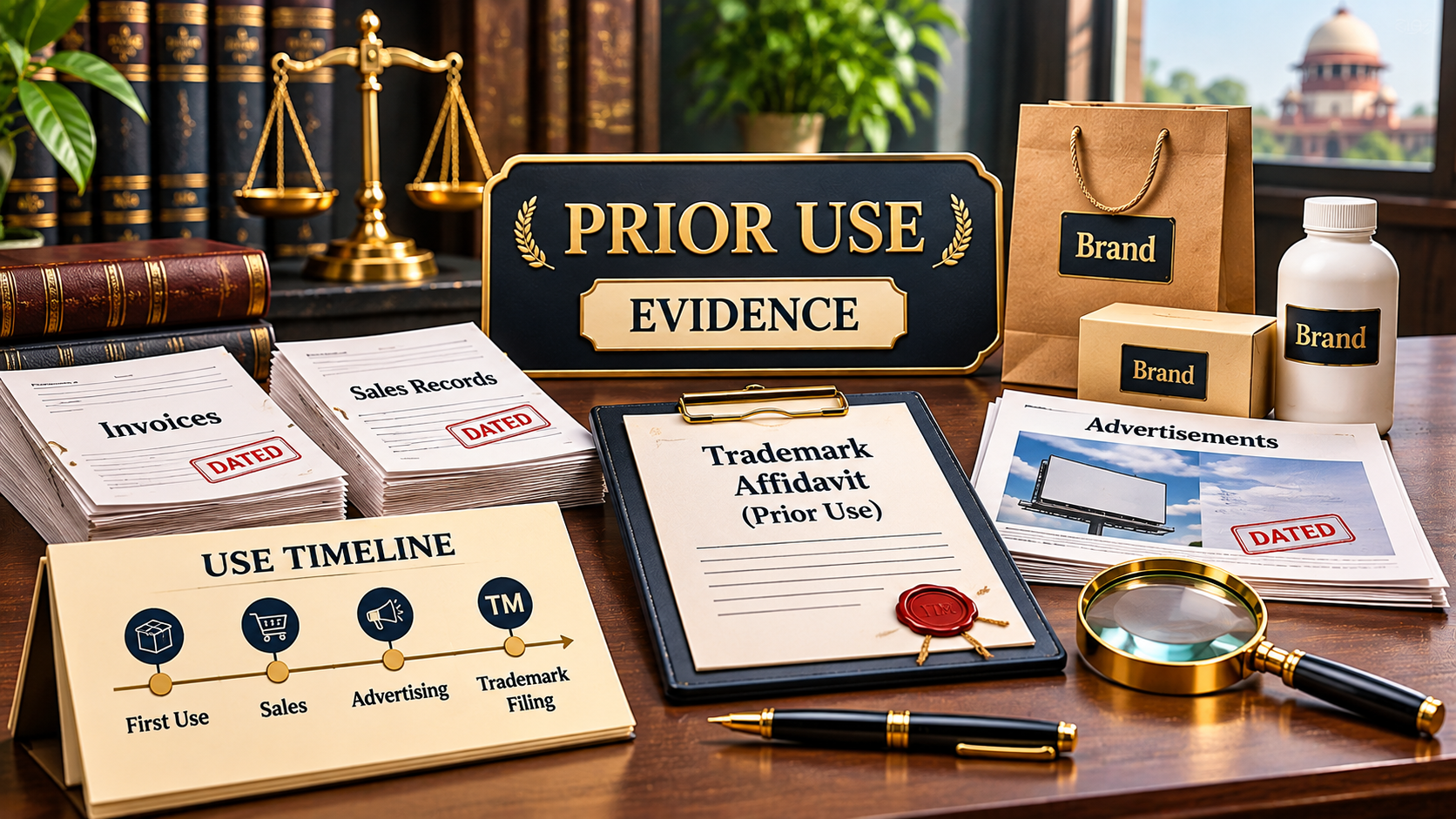
The strongest evidence is usually contemporaneous, business-generated and capable of being independently corroborated. Depending on the business and the mark, documents may include:
- Sales invoices, bills and tax invoices showing the mark, date and goods or services.
- Purchase orders, delivery challans, dispatch records and customer orders.
- Product packaging, labels, tags, brochures and catalogues bearing the mark.
- Website pages, archived listings, dated social-media posts and digital advertisements.
- Marketing contracts, campaign invoices, media releases and advertising expenditure records.
- GST returns, sales ledgers or other accounting records that corroborate the transactions.
- Service agreements, client communications, work orders, completion reports or service records for service marks.
- Distributor, dealer or franchise records where the mark was used through commercial partners.
Not every document proves trademark use on its own. The applicant should show the mark’s connection to the relevant goods or services, the date, and the commercial context.
4. What should the prior-use affidavit contain?
A well-prepared affidavit should identify the deponent and their authority or knowledge of the business records, the mark as used, the claimed date or period of use, the goods/services connected with the use, the business or proprietor using the mark, the nature and extent of commercial activity, and the documents relied upon. Where applicable, it should explain changes in business name, ownership, trading style or the way the mark is displayed.
Dates and descriptions should be precise. If the evidence shows only use for a particular product, the affidavit should not assert use for an unrelated category of goods or services.
5. Evidence for goods and evidence for services
For goods, evidence may include invoices, product photographs, packaging, labels, stock records, delivery documents and sales data. Ideally, the documents visibly connect the mark to the goods being sold and establish a date.
For services, useful records may include service contracts, proposals accepted by customers, invoices, work reports, online booking pages, advertisements, client correspondence and proof of service delivery. A logo appearing on a website without evidence of the relevant service activity may have limited evidentiary value in a particular context.
6. Establishing the date of first use
Applicants should identify the earliest reliable evidence and cross-check it against records from the same period. A document created later may refer to an earlier launch, but it should not be treated as equivalent to contemporaneous proof without explanation. If the business commenced activity gradually, distinguish the date of first advertising, first offer, first sale, first service and sustained commercial use where those dates differ.
Keep original records where possible. If relying on digital records, preserve full-page captures, URLs, timestamps and source files. A cropped screenshot that omits the date, account identity or context may be less persuasive.
7. Prior use through a predecessor or related entity
Where use began with a predecessor, partnership, proprietorship, group company or another entity, the applicant should explain the chain of rights and the relationship between the earlier user and current applicant. Documents such as assignment deeds, business-transfer agreements, succession records, partnership changes or other relevant instruments may be required depending on the facts.
Do not assume that use by a separate legal entity automatically establishes use by the applicant. Ownership, authorization, continuity and the legal basis on which the applicant relies should be addressed clearly.
8. Prior use and the legal importance of earlier rights
Section 34 of the Trade Marks Act, 1999 contains a saving for certain vested prior-use rights. It addresses continuous use by a person or predecessor in relation to goods or services before the relevant earlier trademark use or registration, whichever statutory date is earlier. Its application is fact-sensitive and requires proof of the qualifying use and continuity.
Prior-use evidence can also arise in opposition, passing-off or infringement litigation, but the legal test and evidentiary burden may differ from the user-statement requirements in an application. A filing affidavit should not be assumed to conclusively establish priority in every dispute.
9. Common mistakes when claiming prior use
- Claiming an earliest date based only on memory or an unsupported oral statement.
- Using invoices that do not display or connect the mark to the goods or services.
- Claiming an excessively broad specification based on limited evidence.
- Ignoring inconsistencies between affidavit dates, GST/accounting records, website history and application details.
- Submitting screenshots without preserving their source, date and context.
- Failing to explain use by a predecessor or a different entity.
- Using promotional material that shows an intention to launch but not actual commercial use, without distinguishing it from other evidence.
10. A practical evidence checklist
- Identify the mark and the exact goods/services for which prior use is claimed.
- Prepare a chronological timeline of use and commercial milestones.
- Collect dated primary documents for the earliest period and subsequent continuity.
- Match each exhibit to the mark and the relevant goods/services.
- Check applicant identity and ownership history.
- Reconcile the affidavit with the TM-A particulars and all business records.
- Organise exhibits, label them consistently and retain originals or verifiable source records.
- Have the affidavit and supporting evidence reviewed before filing.
Frequently Asked Questions
1. Is an affidavit mandatory for claiming prior use?
Rule 25(2) requires an affidavit testifying to the claimed use along with supporting documents when use before the application date is claimed.
2. Can I claim prior use without invoices?
Other reliable evidence may support the claim, depending on the circumstances, but invoices and transaction records can be useful contemporaneous proof. Evidence should be sufficient and consistent for the claim made.
3. Do advertisements alone prove prior use?
Advertisements may help establish promotion or public exposure. Their weight depends on whether they are dated, authentic and connected to the relevant goods/services and commercial activity.
4. Can website screenshots prove use?
They can be part of the evidence. Preserve URL, capture date, source, account or business identity, and surrounding context; screenshots should be corroborated where possible.
5. Can a company claim use that began with its founder personally?
That requires a careful factual and legal explanation. Individual use is not automatically company use; ownership, transfer, authorization and continuity should be supported.
6. Can I claim use for all classes based on one invoice?
Not automatically. Evidence must reasonably relate to the goods or services for which use is claimed. A single document may not support a broad multi-class specification.
7. What if my earliest proof is later than the claimed date?
Reassess the claim and identify reliable evidence for the earlier date. Avoid stating a date that cannot be substantiated; explain gaps honestly.
8. Does prior use guarantee trademark registration?
No. Prior use is relevant but does not eliminate examination, statutory objections, conflicts, opposition or other registration requirements.
9. Is prior use relevant in an infringement case?
It may be relevant to rights, priority, defences or other issues, but the applicable legal test depends on the proceedings and evidence.
10. How should evidence be arranged?
Use a dated chronology, clearly numbered exhibits and a brief index identifying each document, date, source and what it supports. Preserve originals and verifiable digital copies.
Disclaimer
This article is for general informational purposes only and is not legal advice. The appropriate prior-use claim and evidence depend on the mark, applicant, goods/services, ownership history and applicable law. Reading this article or contacting the website does not create an advocate-client relationship.
Post Views: 39