
Motor Accident Compensation Claims in India: Damages,…
Important Disclaimer: This article is for general legal information and educational purposes only. It is…
EXCELLENT Based on 66 reviews
 Posted on Google

 Nabeel AkhtarFacing a criminal case can be stressful, but Advocate Nikhil Rathod made the entire process manageable. His strategic approach and strong representation gave me great relief.Posted on Google
 Srinath KarliAn experienced and sharp lawyer. Truly fast and great precise advocacy services offered. Highly recommended! Thankyou.Posted on Google
 SHIVA GAIKWAD
Trustindex verifies that the original source of the review is Google.
Good experience 👍👍👍👍Posted on Google Mangesh LawandeBest advocate for getting justice in Pune he is a very kind by nature 😊✨💫
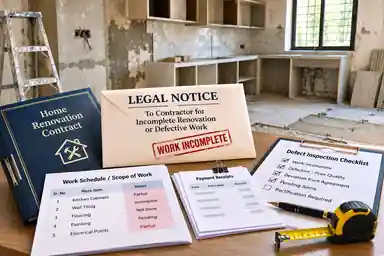
Hiring a contractor for home renovation, interior work, repairs or construction can become stressful when work is abandoned, delayed, left incomplete or executed with defects. A legal notice to a contractor for incomplete work records the agreed scope, identifies the breach, gives a fair opportunity to inspect and rectify, and states the remedy sought—completion, correction, refund of unutilised advance, or compensation for proven loss.
Before sending a notice, review the signed agreement or accepted quotation, payment milestones, drawings/specifications, completion date, warranty and termination clauses. Preserve dated photographs and videos, messages, invoices and a room-wise defect list. If the work is technical, obtain an independent architect, engineer or quantity-surveyor report and a written estimate for rectification or completion.
Contents
A notice may be appropriate where the contractor has:
Not every delay is automatically a breach. Check whether the contract permits extensions for client changes, delayed approvals, material shortages, force majeure or other events. The notice should identify the actual contractual obligation and the evidence of non-performance—not merely state that the work is unsatisfactory.
Indian Contract Act, 1872: Sections 37 and 39 address performance and refusal to perform a promise wholly. Section 55 deals with failure to perform at a fixed time where time is essential. Section 73 permits compensation for loss or damage that naturally arose from the breach or was within the parties’ contemplation; remote or speculative loss is not recoverable. Section 74 governs reasonable compensation where a contract stipulates a sum or penalty, and Section 75 addresses compensation after rightful rescission. Read the Indian Contract Act, 1872.
In Kailash Nath Associates v. Delhi Development Authority, (2015) 4 SCC 136, the Supreme Court explained that Section 74 awards reasonable compensation, not an automatic windfall; legal injury and the circumstances of the breach remain material. In Fateh Chand v. Balkishan Das, AIR 1963 SC 1405, the Court held that a penalty or forfeiture clause does not automatically entitle a party to retain the whole stipulated amount. These principles matter when a contractor claims to forfeit an advance or the customer seeks a contractual penalty.
Consumer Protection Act, 2019: If the renovation or construction service was hired for personal residential use and the claimant meets the statutory definition of “consumer”, a complaint may be available for deficiency in service under Sections 2(11), 35 and 39. The commercial-purpose exclusion and the nature of the contract must be considered. Section 69 generally prescribes a two-year period from the cause of action, subject to condonation for sufficient cause. See the Consumer Protection Act, 2019.
Specific relief and arbitration: Specific performance or an injunction may be considered only where the contract and statutory requirements permit it; not every renovation contract can be specifically enforced. Sections 10, 14 and 20 of the Specific Relief Act, 1963 are relevant. If the agreement contains an arbitration clause, check its notice procedure. A notice invoking arbitration under Section 21 of the Arbitration and Conciliation Act, 1996 should identify the dispute and comply with the agreement.
A well-drafted notice should set out:
Quantify the claim carefully. Deduct the value of work actually completed and usable materials where appropriate. Separate the unutilised advance, rectification estimate, replacement-contractor cost and other direct loss. Do not claim the entire contract price as damages without accounting for the benefit received, and do not assume a contractual penalty is automatically payable.
Send the notice to the address and email specified in the contract, and to any updated business address supported by records. Registered Post A.D. or Speed Post with tracking is commonly used; email may be sent as an additional channel where appropriate. Keep the signed notice, postal receipt, tracking/delivery proof, sent email and attachments. A response period of 7–15 days is often requested depending on the work and urgency, but there is no universal statutory notice period for every private contractor dispute.
Before engaging a replacement contractor, check the termination and cure clauses, give any required notice, document the site condition and preserve materials. Taking reasonable steps to mitigate loss helps support a later damages claim. If the contractor is a government entity or a special statutory regime applies, verify any mandatory pre-suit notice separately.
A civil claim for compensation for breach of contract is commonly governed by Article 55 of the Limitation Act, 1963, which generally provides three years from the relevant breach; the starting point can differ for successive or continuing breaches and depends on the contract and facts. Consumer complaints generally have a two-year period under Section 69 of the Consumer Protection Act. The Limitation Act, 1963 should be checked for the specific cause of action. Sending a legal notice does not automatically extend limitation.
That, despite receiving payments of ₹[amount] under the agreement dated DD/MM/YYYY, you have failed to complete/rectify the items listed in Annexure A, contrary to clauses [___]. You are called upon to attend a joint inspection within [7] days and complete the outstanding work or provide a written rectification plan by DD/MM/YYYY. Failing compliance, my client reserves the right—subject to the contract and applicable law—to terminate/rescind where entitled, engage a replacement contractor after documenting the site, and recover the unutilised advance, reasonable completion/rectification costs and other proven loss.
For a printable sample with a work-scope and defect checklist, use the Legal Notice to Contractor for Incomplete or Defective Work PDF Template. Adapt the clauses to the contract and evidence before dispatch.
Yes. An accepted quotation, invoices, payment records, messages, drawings and conduct may help establish the contract and scope. The notice should state the evidence relied upon.
Usually not for an ordinary private contract claim, unless the agreement or a special law requires it. A notice is useful to record the breach and give an opportunity to cure.
Choose a reasonable period based on the defect, work required and contract. Seven to fifteen days is commonly requested, but it is not a universal statutory deadline.
Possibly, but first check termination/cure clauses, the seriousness of breach and any required notice. Document the site and costs, and avoid double recovery.
You may claim the unutilised or unearned amount and legally recoverable loss, but the account should consider work completed, usable materials and contractual terms.
Review written variation approvals, messages, measurements and invoices. Identify disputed and undisputed items separately; do not ignore a genuine variation claim.
It may be available where the service was hired for personal use and the claimant qualifies as a consumer. Commercial-purpose and jurisdiction issues must be checked.
Follow the clause and consider a Section 21 notice invoking arbitration. A general demand notice may not satisfy the formal requirements for commencement.
A civil breach-of-contract claim commonly has three years under Article 55, while a consumer complaint generally has two years under Section 69. The precise starting date depends on the facts.
Keep delivery proof and proceed before the competent forum—civil court, Consumer Commission or arbitral tribunal—after checking jurisdiction, limitation and the contract.
Disclaimer: This article is for general information and does not replace advice based on the contract, site condition, evidence and applicable forum.
+91 820 890 9423
desk@tridentlegal.in
Flat No. 302, Kalunkhe Niwas, Khopade Nagar, Gujaewadi, Katraj, Pune - 411041


I was really impressed with Trident Legal and Advocate Nikhil Rathod. Even though they just started,
Trident Legal and Advocate Nikhil Rathod are really good at what they do. Even though they
I had a great experience with Trident Legal and Advocate Nikhil Rathod. Even though they are
Trident Legal, with Advocate Nikhil Rathod, is like a rising star in the legal world. I
I was lucky to work with Trident Legal and Advocate Nikhil Rathod. Even though they just
Trident Legal and Advocate Nikhil Rathod are really amazing! They helped me with legal stuff and
Trident Legal and Advocate Nikhil Rathod are like superheroes! They are really good at legal stuff
I wasn’t sure about Trident Legal because they are new, but they surprised me! Advocate Nikhil
I had the honor of working with Trident Legal and Advocate Nikhil Rathod. They were really
Trident Legal, led by Advocate Nikhil Rathod, is like a superhero in the legal world. Even

Important Disclaimer: This article is for general legal information and educational purposes only. It is…
Learn how to send a legal notice in India by post, Speed Post, courier, email…
Ignoring a legal notice does not automatically make you liable. Learn the legal consequences, statutory…

A legal-status update on India's draft Seeds Bill 2025 and Pesticides Management Bill 2025, explaining…

The National Food Security (Amendment) Bill, 2026 remains a consultation draft. Understand the proposed AAY…

A 2027 guide to SEBI’s latest securities-market regulations: the new Portfolio Managers Regulations, stockbroker and…
