

Mutual Divorce Settlement Agreement in Pune: Alimony,…
A practical legal guide to mutual divorce settlement agreements in Pune, covering alimony, child custody,…
EXCELLENT Based on 66 reviews
 Posted on Google
 Nabeel AkhtarFacing a criminal case can be stressful, but Advocate Nikhil Rathod made the entire process manageable. His strategic approach and strong representation gave me great relief.Posted on Google
 Srinath KarliAn experienced and sharp lawyer. Truly fast and great precise advocacy services offered. Highly recommended! Thankyou.Posted on Google
 SHIVA GAIKWAD
Trustindex verifies that the original source of the review is Google.
Good experience 👍👍👍👍Posted on Google Mangesh LawandeBest advocate for getting justice in Pune he is a very kind by nature 😊✨💫
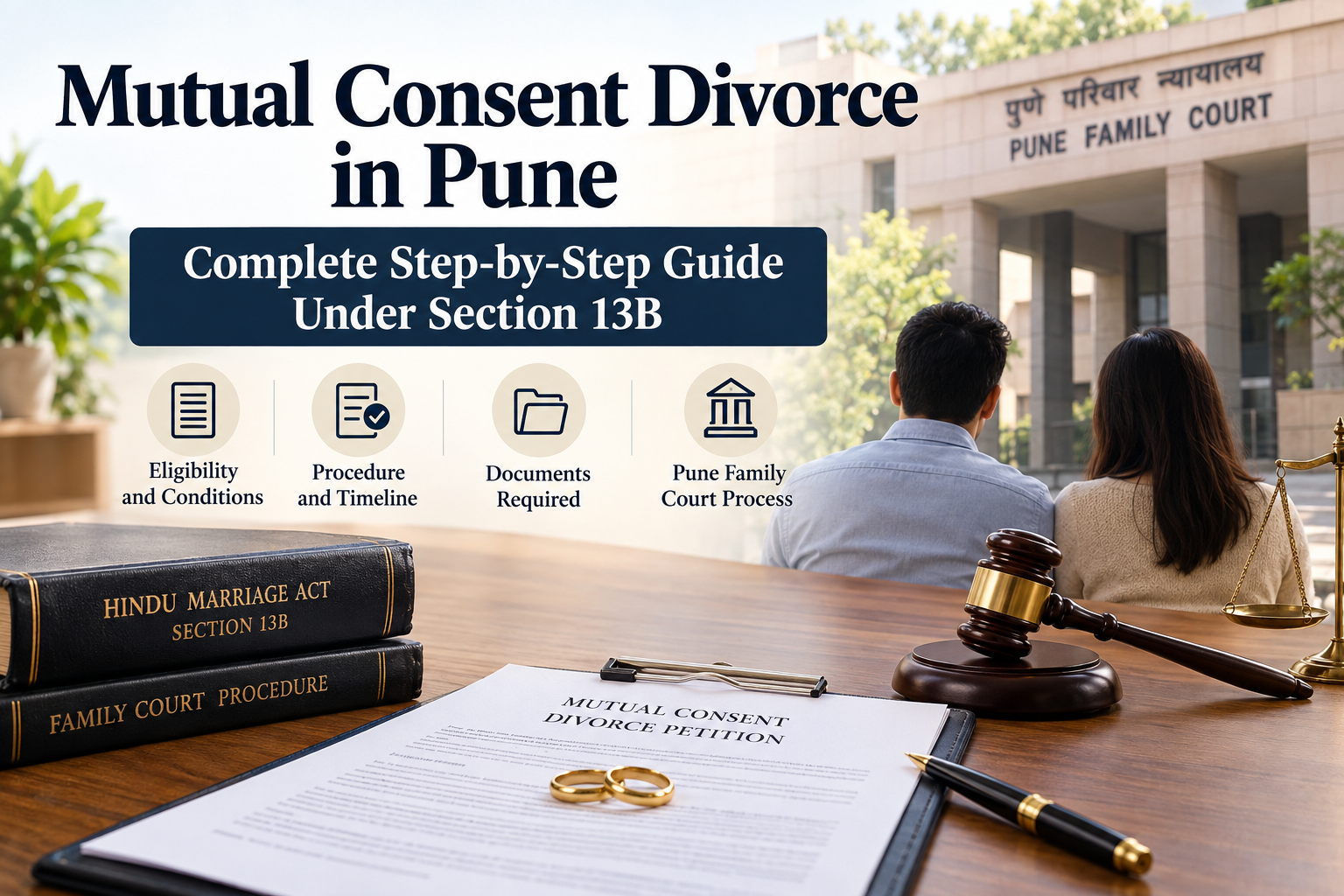
Mutual consent divorce in Pune is a legal process through which spouses who have jointly decided that their marriage should end may seek a decree of divorce by mutual consent. For couples who are able to agree on the major issues arising from the marriage, Section 13B of the Hindu Marriage Act, 1955 provides a statutory route for dissolution of marriage by mutual consent.
The process is not simply a matter of signing a divorce agreement. The court has to be satisfied about the statutory requirements, the parties’ consent and the relevant matrimonial circumstances. Depending on the facts, the proceedings may involve a first motion, a waiting period, a second motion, settlement terms relating to maintenance or permanent alimony, child custody and other issues, and finally a decree of divorce.
This guide explains the mutual consent divorce procedure in Pune, the requirements under Section 13B, the documents generally required, the first and second motions, the six-month period and its possible waiver, settlement issues, jurisdiction and practical points that couples should understand before commencing proceedings.
Mutual consent divorce means that both spouses jointly seek dissolution of their marriage and continue to consent to the divorce in accordance with the applicable matrimonial law. Under Section 13B of the Hindu Marriage Act, 1955, the statutory process is available where the parties satisfy the requirements prescribed by the provision.
The important feature is continuing and genuine consent. A mutual-consent petition cannot be treated in the same manner as a contested divorce in which one spouse seeks a decree on a statutory ground against the wishes of the other. Both spouses must participate in the statutory process and make the necessary statements before the court.
Where the marriage is governed by the Hindu Marriage Act, Section 13B may apply if the statutory conditions are satisfied. The parties should ordinarily have been living separately for a period of at least one year or more immediately before presentation of the petition, should have been unable to live together, and should have mutually agreed that the marriage ought to be dissolved.
The expression “living separately” does not necessarily mean that the spouses must live in two different cities or two different houses in every case. The legal question depends on the facts and the nature of the marital relationship. The circumstances should therefore be stated accurately in the petition.
For a Hindu marriage, the principal statutory requirements generally considered under Section 13B include:
The court may also examine the settlement between the parties and whether consent is voluntary and genuine. Where there are children, maintenance claims, property issues or other matrimonial proceedings, those matters should be considered carefully while preparing the settlement.
Jurisdiction depends upon the applicable matrimonial law and the facts concerning the marriage and residence of the parties. Depending on the circumstances, jurisdiction may be connected with the place where the marriage was solemnised, where the parties last resided together, where the wife is residing at the relevant time, or other statutory considerations.
For a couple intending to proceed before the Pune Family Court, the petition should first be examined for territorial and subject-matter jurisdiction. A Pune connection alone should not be assumed to be sufficient without checking the facts and applicable statutory provision.
Before filing, spouses should identify the issues that need to be resolved. These can include permanent alimony or maintenance, return of articles or belongings, child custody, visitation, education expenses, medical expenses, property arrangements, pending litigation and other financial or personal claims.
A settlement should be clear enough to reduce future disputes. It should also accurately reflect what the parties have actually agreed to do. A vague statement that “all disputes are settled” may not adequately explain the practical obligations of either spouse.
The relevant marriage law, period of separation, jurisdiction and other statutory requirements should be checked before filing. If the marriage is governed by a law other than the Hindu Marriage Act, the applicable provision may be different.
The spouses ordinarily present a joint petition setting out the marriage details, separation, inability to live together, mutual decision to dissolve the marriage and other relevant facts. The petition should correspond with the documents and the parties’ actual circumstances.
The first motion is the initial stage of the Section 13B proceeding. Both spouses are required to participate in the process. The court considers the pleadings, statements and statutory requirements before proceeding further.
The exact procedure, dates and manner of recording statements can depend on the court’s directions and the circumstances of the case. A couple should not assume that filing the petition itself automatically results in a divorce decree.
Section 13B(2) ordinarily contemplates a period between the first motion and the second motion. The purpose of the statutory period includes giving the parties an opportunity to reconsider the decision and permitting reconciliation efforts where appropriate.
The waiting period is often referred to as the six-month cooling-off period. It is important to understand that this period should not be described as an absolute requirement in every case. The Supreme Court has held that the period under Section 13B(2) is directory and that the court may consider waiver in appropriate circumstances.
At the second-motion stage, the court considers whether the parties continue to consent to dissolution of the marriage and whether the statutory requirements remain satisfied. If either spouse withdraws consent, the mutual-consent route may not be available in the same form.
If the court is satisfied that the requirements are fulfilled and the parties continue to consent, a decree of divorce may be passed. The marriage is then dissolved in accordance with the decree and applicable law.
Yes, in appropriate cases. The Supreme Court in Amardeep Singh v. Harveen Kaur held that the six-month period under Section 13B(2) is directory rather than an absolute mandatory bar. The court may exercise discretion to waive the period depending on the circumstances.
In Amardeep Singh, the Supreme Court discussed circumstances relevant to waiver, including the possibility that reconciliation has failed, the parties have genuinely settled their disputes and continuation of the waiting period would serve no useful purpose. Subsequent Supreme Court decisions have clarified that the conditions discussed in that judgment should not be treated mechanically as though they were statutory text.
In Amit Kumar v. Suman Beniwal, the Supreme Court explained that the principles in Amardeep Singh should not be read with excessive rigidity and that the court has to consider the facts of the particular matter while deciding whether waiver should be granted.
A recent decision of the Bombay High Court is particularly relevant to couples considering mutual consent divorce in Pune. On 7 September 2026, the High Court set aside a Pune Family Court order that had refused a couple’s request to waive the six-month period.
The couple had jointly sought divorce under Section 13B and stated that they had been living separately for more than 18 months. The Bombay High Court considered the circumstances in which the Pune Family Court had refused the waiver and held that the lower court should not have independently raised a financial issue where the spouses themselves were not disputing the financial settlement.
The decision should not be understood to mean that every mutual-consent divorce in Pune will receive an automatic waiver. The question of waiver remains dependent on the circumstances and judicial discretion. The decision does, however, illustrate the importance of clearly presenting the parties’ actual settlement and the issues that genuinely remain in dispute.
The documents vary according to the facts, but a petition may commonly require documents such as:
The precise documents should be determined after examining the marriage, jurisdiction and settlement rather than relying on a generic checklist.
A settlement should address the issues that are actually relevant to the spouses. Depending on the case, it may cover:
Particular care is necessary where children or substantial financial assets are involved. A settlement should not merely state that the parties have no claims if important rights or obligations have not actually been addressed.
If the spouses have minor children, the settlement can record the proposed custody and parenting arrangements. It may address physical custody, visitation, communication, school-related decisions, medical expenses and other practical matters.
However, an agreement between parents does not mean that the child’s welfare becomes irrelevant. Courts continue to consider the welfare and best interests of the child in accordance with the applicable law.
Alimony or maintenance is often one of the most important issues in a mutual-consent settlement. The spouses may agree upon a lump-sum amount, periodic payment or another legally permissible arrangement, depending on their circumstances.
The settlement should specify the amount, payment schedule, mode of payment and consequences of non-payment where appropriate. It should also distinguish between obligations relating to the spouse and expenses relating to children.
Mutual consent must continue through the statutory process. If one spouse withdraws consent before the decree is passed, the court ordinarily cannot treat the matter as a mutual-consent divorce merely because consent existed when the petition was initially filed.
This is why couples should understand the legal effect of their settlement and the stages of the proceeding before filing. A settlement document does not eliminate the requirement of continuing consent under Section 13B.
There is no universal answer. The statutory structure, court schedule, facts of separation, first-motion date, second-motion requirements and any application for waiver all affect the timeline.
Where the six-month period is not waived, the second motion ordinarily cannot be treated as though the statutory interval does not exist. Where waiver is sought, the court must consider the facts and applicable legal principles. Therefore, a fixed promise that every mutual divorce will be completed within a particular number of days would be legally inappropriate.
A waiver application may be considered where the legal and factual circumstances justify it. The court may examine the period of separation, the status of reconciliation efforts, settlement of relevant disputes and whether continuation of the waiting period would serve a meaningful purpose.
Because waiver is discretionary, the petition and waiver application should accurately explain the circumstances rather than merely stating that both parties want an early decree.
Spouses do not necessarily have to reside in the same city throughout the process. Jurisdiction and the court’s procedural directions determine where the petition can be presented and how appearances or statements are handled.
Where one spouse lives in Mumbai, another in Pune or either spouse lives outside Maharashtra, the jurisdiction should be examined before filing. Special issues may also arise where one spouse is residing outside India.
An NRI or overseas-residence situation can involve additional questions concerning jurisdiction, service, powers of attorney, appearance, authentication of documents and the recognition of a decree in another country. The applicable foreign-law consequences should not be assumed from Indian procedure alone.
Where either spouse is outside India, the proposed procedure should be checked against the requirements of the court and the country of residence before documents are prepared.
Mutual consent divorce and contested divorce are fundamentally different procedural routes.
A mutual-consent petition may be procedurally more straightforward where genuine agreement exists, but it is not appropriate where one spouse does not voluntarily agree to the divorce or where important issues cannot be settled.
Some recurring problems can be avoided through careful preparation:
Before presenting a petition, spouses should consider the following:
It is a statutory process through which spouses who mutually agree to dissolve their marriage jointly approach the competent court, subject to the requirements of the applicable matrimonial law.
Section 13B provides the statutory framework for divorce by mutual consent for marriages governed by the Hindu Marriage Act, subject to its requirements.
Section 13B(1) generally requires the spouses to have been living separately for a period of one year or more immediately before presentation of the petition.
The Supreme Court has held that the six-month period under Section 13B(2) is directory and may be waived by the court in appropriate circumstances.
Yes, a waiver may be considered in an appropriate case. It is not automatic and depends upon the facts and judicial discretion.
No. The court must consider the circumstances of the particular case, including the status of reconciliation and settlement of relevant disputes.
The spouses initiate the Section 13B proceeding and participate in the court process. The court considers the petition, statements and applicable statutory requirements.
The court considers whether both spouses continue to consent and whether the requirements for passing a decree of mutual consent divorce are satisfied.
Yes. A spouse may withdraw consent before the decree, and continuing mutual consent is an important requirement of the mutual-consent route.
Potentially, depending on the applicable jurisdictional provisions and facts. Living in different cities does not by itself prevent a mutual-consent proceeding.
Common documents include marriage proof, identity and address documents, photographs, jurisdiction-related documents and relevant settlement or proceeding documents. The exact list depends on the case.
Spouses may agree upon maintenance or permanent alimony as part of a settlement, subject to the applicable law and the terms of the agreement.
Parents may record agreed custody, visitation and expense arrangements, but the child’s welfare remains an important consideration for the court.
Relevant property and financial arrangements may be included in a settlement, provided the agreement is legally permissible and clearly records the parties’ obligations.
In appropriate cases, yes, but jurisdiction, appearance, service, documentation and recognition issues may require additional consideration.
It can be procedurally shorter where both spouses genuinely agree and all relevant issues are settled, but the actual timeline depends on statutory requirements, court scheduling and the facts of the case.
No. The marriage continues until the competent court passes the decree of divorce.
The appropriate timing and procedure depend on the facts and the court’s practice. The legal basis for waiver should be established through the circumstances of the case.
Parties may agree upon appropriate steps concerning pending proceedings, but the legal method of disposal depends on the nature of each proceeding and the applicable law.
Different matrimonial statutes contain different provisions. The applicable mutual-consent provision should therefore be identified from the law governing the marriage.
Mutual consent divorce in Pune involves more than filing a joint petition. The spouses must satisfy the statutory requirements, understand the first and second motions, address financial and family issues, and maintain genuine consent through the proceeding. The six-month period under Section 13B(2) may be waived in appropriate circumstances, but waiver is not automatic.
The recent Bombay High Court decision concerning a Pune Family Court order also demonstrates why the facts and settlement should be presented accurately and why courts consider the actual issues between the spouses. Couples should therefore approach the process with a clear understanding of their rights, obligations, settlement terms and the applicable procedural requirements.
Important Disclaimer
This article is provided solely for general legal information and public awareness. It is not legal advice, legal opinion, or a legal solution to any specific facts or circumstances. Laws and their interpretation may change, and the application of law depends upon the facts of each individual matter. Readers should not rely upon this article as a substitute for obtaining appropriate legal advice concerning their specific circumstances. Nothing contained in this article creates, establishes or constitutes an advocate-client relationship between the reader and Trident Legal Services, Advocate Nikhil Rathod, or any other person associated with the publication.
+91 820 890 9423
desk@tridentlegal.in
Flat No. 302, Kalunkhe Niwas, Khopade Nagar, Gujaewadi, Katraj, Pune - 411041


I was really impressed with Trident Legal and Advocate Nikhil Rathod. Even though they just started,
Trident Legal and Advocate Nikhil Rathod are really good at what they do. Even though they
I had a great experience with Trident Legal and Advocate Nikhil Rathod. Even though they are
Trident Legal, with Advocate Nikhil Rathod, is like a rising star in the legal world. I
I was lucky to work with Trident Legal and Advocate Nikhil Rathod. Even though they just
Trident Legal and Advocate Nikhil Rathod are really amazing! They helped me with legal stuff and
Trident Legal and Advocate Nikhil Rathod are like superheroes! They are really good at legal stuff
I wasn’t sure about Trident Legal because they are new, but they surprised me! Advocate Nikhil
I had the honor of working with Trident Legal and Advocate Nikhil Rathod. They were really
Trident Legal, led by Advocate Nikhil Rathod, is like a superhero in the legal world. Even

A practical legal guide to mutual divorce settlement agreements in Pune, covering alimony, child custody,…
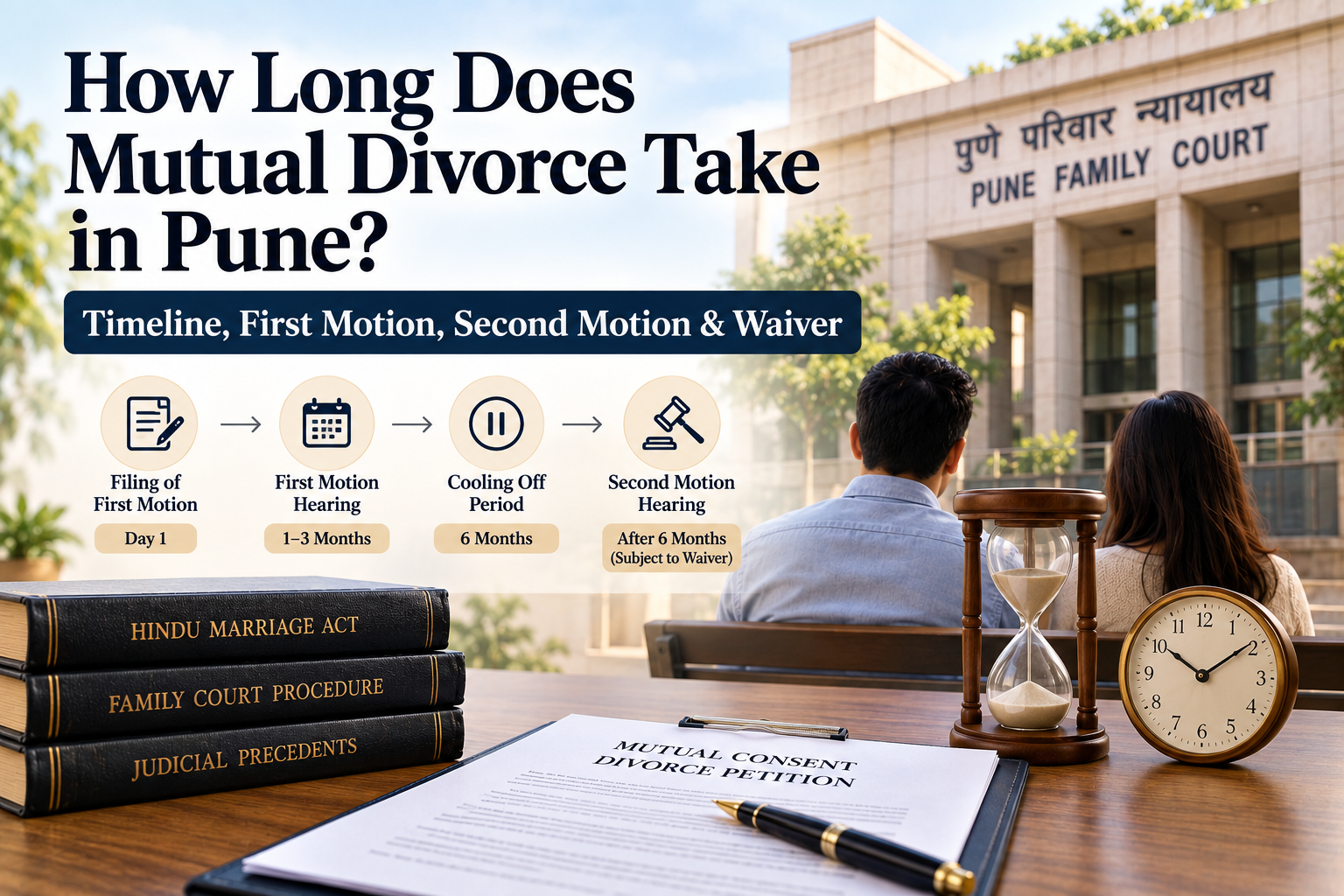
Understand how long mutual divorce takes in Pune, including the one-year separation requirement, first motion,…
A complete guide to mutual consent divorce in Pune, covering Section 13B, eligibility, documents, first…
A legal guide to motor accident claims in India covering MACT procedure, documentation, compensation, insurance,…
