
Mutual Divorce and Social Media in Pune:…
Social media and digital communication have become closely connected with matrimonial relationships. Couples may have…
EXCELLENT Based on 66 reviews
 Posted on Google
 Nabeel AkhtarFacing a criminal case can be stressful, but Advocate Nikhil Rathod made the entire process manageable. His strategic approach and strong representation gave me great relief.Posted on Google
 Srinath KarliAn experienced and sharp lawyer. Truly fast and great precise advocacy services offered. Highly recommended! Thankyou.Posted on Google
 SHIVA GAIKWAD
Trustindex verifies that the original source of the review is Google.
Good experience 👍👍👍👍Posted on Google Mangesh LawandeBest advocate for getting justice in Pune he is a very kind by nature 😊✨💫

Can mutual divorce be filed before one year of marriage in India? In the ordinary course, a petition for divorce under Section 13B of the Hindu Marriage Act, 1955 cannot be entertained before one year has elapsed from the date of marriage. However, Section 14 of the Hindu Marriage Act contains a limited statutory mechanism under which the court may permit presentation of a divorce petition before the expiry of one year where the case involves exceptional hardship to the petitioner or exceptional depravity on the part of the respondent.
This issue is different from the six-month period that ordinarily applies between the first and second motions in a mutual-consent divorce. The two waiting periods arise at different stages and should not be confused.
Section 14 of the Hindu Marriage Act provides that, subject to its proviso, a court is not competent to entertain a petition for dissolution of marriage by a decree of divorce unless one year has elapsed from the date of marriage on the date of presentation of the petition.
For a normal mutual-consent divorce under Section 13B, therefore, spouses generally need to wait until the statutory one-year period has elapsed before presenting the petition. The fact that both spouses agree to divorce does not, by itself, remove the Section 14 restriction.
There is a limited exception. The proviso to Section 14 allows the court, on an application made in accordance with the applicable rules, to permit presentation of a divorce petition before one year has elapsed where the case is one of exceptional hardship to the petitioner or exceptional depravity on the part of the respondent.
This is not a general early-divorce facility. The statutory language sets a high threshold, and the circumstances must justify departure from the ordinary one-year rule.
Section 14 does not itself grant a divorce before one year. It permits the court to allow the petition to be presented before the one-year period has expired if the statutory grounds are established.
Accordingly, there are two separate questions:
Obtaining permission under Section 14 should therefore not be described as an automatic decree of divorce.
The expression exceptional hardship requires something more than ordinary matrimonial disagreement, incompatibility or regret shortly after marriage. The facts must be sufficiently serious and unusual to justify permitting the statutory one-year restriction to be crossed at the petition stage.
The court considers the circumstances of the particular case. The exact assessment depends upon the evidence and the applicable procedural rules. A party seeking permission should therefore explain the specific hardship rather than merely state that the marriage has failed.
Exceptional depravity refers to circumstances of an unusually serious nature attributable to the other spouse. The statutory expression sets a demanding threshold and should not be treated as synonymous with every matrimonial allegation.
Where reliance is placed on exceptional depravity, the application should clearly identify the conduct relied upon and the material supporting it. General allegations without sufficient particulars may not establish the statutory ground.
No. The fact that both spouses have agreed that the marriage should end does not automatically satisfy Section 14. Mutual consent addresses the requirements of Section 13B; Section 14 separately governs the question of whether the petition may be presented before one year.
A joint settlement, absence of children, short marriage or complete agreement about finances may be relevant background facts, but they do not by themselves establish exceptional hardship or exceptional depravity.
| Issue | One-year rule | Six-month period |
|---|---|---|
| Relevant provision | Section 14, Hindu Marriage Act | Section 13B(2), Hindu Marriage Act |
| Stage | Before presentation of the divorce petition | After presentation of the first-motion petition |
| Ordinary period | One year from marriage | Six months from presentation of first petition |
| Possible judicial relief | Permission to present petition early on statutory grounds | Waiver in appropriate cases under Supreme Court principles |
| Does relief automatically grant divorce? | No | No |
This distinction is particularly important in drafting. An application under Section 14 should not be described as a request to waive the six-month cooling-off period.
In a Supreme Court decision dealing with Sections 13B and 14 of the Hindu Marriage Act, the Court reproduced the statutory scheme and explained that Section 14 ordinarily prevents entertainment of a divorce petition before one year from the marriage, while its proviso permits early presentation in a case of exceptional hardship to the petitioner or exceptional depravity of the respondent.
The same decision also distinguishes this issue from the six-month period under Section 13B(2). The statutory one-year bar and the post-filing cooling-off period therefore operate at different stages.
The application under the proviso to Section 14 is considered by the competent court in accordance with the applicable High Court rules and procedure. The court must be satisfied that the statutory threshold is met before permitting the petition to be presented early.
The applicant should not assume that filing a joint Section 13B petition itself cures the one-year defect. Where the marriage is less than one year old, the Section 14 issue should be addressed expressly if an early petition is sought.
If the court permits presentation of the petition, the parties still have to satisfy the requirements of the substantive divorce provision. In a mutual-consent matter, this means establishing the requirements under Section 13B, including the statutory separation requirement and continuing mutual consent.
The Section 14 order therefore removes the procedural obstacle concerning the timing of presentation; it does not dispense with the substantive requirements of Section 13B.
No. These are separate concepts. Section 14 concerns the period elapsed since the date of marriage. Section 13B(1) separately requires the parties to have been living separately for a period of one year or more immediately before presentation of the mutual-consent petition.
Thus, even where Section 14 permission is granted, the facts must still satisfy the requirements applicable to a Section 13B petition. The timing requirements should be analysed separately.
Recent separation does not automatically overcome Section 14. If less than one year has elapsed from the marriage, the court must consider whether the Section 14 proviso permits early presentation. In addition, the parties must satisfy the statutory requirements of Section 13B.
The fact that the spouses have been living apart from the early days of the marriage may be relevant evidence, but it does not by itself create an automatic exception.
The appropriate documents depend on the facts. They may include:
Documents should be relevant to the statutory ground actually pleaded. A large collection of unrelated material does not necessarily establish exceptional hardship or depravity.
A settlement agreement can record the spouses’ understanding on matters such as maintenance, property, custody and pending proceedings, but a private settlement cannot override the statutory requirement in Section 14.
If the marriage is less than one year old, the appropriate statutory route for early presentation must still be followed. The court must consider the statutory requirements independently of the parties’ agreement.
The six-month period under Section 13B(2) is a separate issue. The Supreme Court has recognised in Amardeep Singh v. Harveen Kaur and subsequently considered in Amit Kumar v. Suman Beniwal that the cooling-off period can be waived in appropriate circumstances. The existence of this principle does not eliminate the separate one-year rule in Section 14.
A practical way to remember the distinction is:
Recent Supreme Court orders continue to demonstrate that the Court can, in appropriate proceedings, give effect to genuine matrimonial settlements and exercise Article 142 powers. For example, on 27 May 2026, the Supreme Court recorded a settlement in a Section 13B proceeding and granted a mutual-consent decree after the parties participated virtually and confirmed their settlement.
Such Article 142 orders are case-specific. They should not be treated as a general rule that a Family Court can ignore Section 14 or permit every couple married for less than one year to file a mutual-consent petition.
The Supreme Court possesses constitutional power under Article 142 to pass orders necessary to do complete justice in appropriate cases. The Court has exercised that power in matrimonial matters involving settlements. That constitutional jurisdiction is distinct from the ordinary statutory jurisdiction of a Family Court.
Therefore, a Supreme Court order in an individual case should not be treated as establishing an automatic entitlement to early mutual divorce before the statutory period.
Serious matrimonial circumstances may potentially be relevant to an application under Section 14, but the statutory threshold must still be considered. If a spouse relies on exceptional hardship or exceptional depravity, the application should clearly set out the factual basis and supporting material.
Where the parties do not genuinely have mutual consent, a separate analysis under the contested-divorce provisions may be required. The legal route depends upon the facts and the applicable ground of divorce.
Section 39 of the Special Marriage Act contains a restriction concerning the presentation of divorce petitions within one year of marriage and includes a proviso dealing with exceptional hardship or exceptional depravity. The precise statutory wording and procedure should therefore be checked where the marriage is governed by the Special Marriage Act.
This means that the one-year issue is not limited to Hindu Marriage Act matters. However, the relevant provision should be identified from the governing matrimonial statute rather than applying Section 14 of the Hindu Marriage Act mechanically.
Ordinarily, a divorce petition under the Hindu Marriage Act cannot be entertained before one year from marriage, but Section 14 contains a limited exception for exceptional hardship or exceptional depravity.
No. Agreement between the spouses does not by itself remove the Section 14 restriction.
It refers to circumstances sufficiently serious and unusual to justify early presentation of a divorce petition. The assessment is fact-specific.
It refers to unusually serious conduct attributable to the respondent. The statutory threshold is higher than ordinary matrimonial disagreement.
No. A private settlement cannot override Section 14. A statutory application for early presentation must be considered where applicable.
No. Section 14 concerns the timing of presentation before one year from marriage. Six-month waiver concerns the period after a mutual-consent petition has already been filed.
No. It concerns permission to present the petition early. The substantive divorce requirements must still be satisfied.
No. Section 14 concerns time since marriage, while Section 13B separately concerns the required period of living separately.
It may be relevant to the facts, but it does not automatically satisfy the Section 14 exception or the other statutory requirements.
The competent court can consider an application where it has territorial and subject-matter jurisdiction and the statutory requirements are met.
The possibility depends on the governing matrimonial statute, jurisdiction and facts. Cross-border matters require separate consideration of jurisdiction and procedure.
The Supreme Court can exercise Article 142 in appropriate cases, but its case-specific constitutional orders do not create an automatic right to bypass statutory requirements in Family Court proceedings.
The absence of children may simplify some settlement issues, but it does not itself establish exceptional hardship or exceptional depravity.
Yes, parties can negotiate lawful financial terms, but settlement does not itself overcome Section 14.
The evidence depends on the facts. Documents should directly support the specific circumstances pleaded rather than merely establish that the marriage is unhappy.
Ordinary incompatibility or disagreement should not automatically be equated with the statutory expression exceptional hardship.
The application should provide particulars and supporting material where available. A bare allegation may not establish the statutory ground.
If the petition is lawfully presented and the case reaches the Section 13B stage, the separate principles concerning the six-month period may become relevant. The two questions remain legally distinct.
Yes. Section 39 of the Special Marriage Act contains a restriction concerning presentation of divorce petitions within one year and a proviso dealing with exceptional hardship or exceptional depravity.
Yes. The exact date of marriage should be verified from the marriage record, and the filing date should be compared with the statutory period before choosing the procedural route.
For a mutual-divorce matter under the Hindu Marriage Act, one year from the date of marriage is ordinarily a threshold for presentation of the divorce petition. Section 14 provides a limited statutory exception where the court is satisfied that the case involves exceptional hardship to the petitioner or exceptional depravity on the part of the respondent.
This issue should not be confused with the six-month cooling-off period under Section 13B(2). The first concerns whether the petition may be presented before one year; the second concerns the ordinary interval between the first and second motions after the petition has been presented.
For marriages governed by the Special Marriage Act, the corresponding one-year restriction is found in Section 39. The precise procedure should therefore be determined from the statute governing the marriage, the facts, the jurisdiction and the applicable court rules.
Important Disclaimer
This article is provided solely for general legal information and public awareness. It is not legal advice, legal opinion, or a legal solution to any specific facts or circumstances. Laws and their interpretation may change, and the application of law depends upon the facts of each individual matter. Readers should not rely upon this article as a substitute for obtaining appropriate legal advice concerning their specific circumstances. Nothing contained in this article creates, establishes or constitutes an advocate-client relationship between the reader and Trident Legal Services, Advocate Nikhil Rathod, or any other person associated with the publication.
+91 820 890 9423
desk@tridentlegal.in
Flat No. 302, Kalunkhe Niwas, Khopade Nagar, Gujaewadi, Katraj, Pune - 411041


I was really impressed with Trident Legal and Advocate Nikhil Rathod. Even though they just started,
Trident Legal and Advocate Nikhil Rathod are really good at what they do. Even though they
I had a great experience with Trident Legal and Advocate Nikhil Rathod. Even though they are
Trident Legal, with Advocate Nikhil Rathod, is like a rising star in the legal world. I
I was lucky to work with Trident Legal and Advocate Nikhil Rathod. Even though they just
Trident Legal and Advocate Nikhil Rathod are really amazing! They helped me with legal stuff and
Trident Legal and Advocate Nikhil Rathod are like superheroes! They are really good at legal stuff
I wasn’t sure about Trident Legal because they are new, but they surprised me! Advocate Nikhil
I had the honor of working with Trident Legal and Advocate Nikhil Rathod. They were really
Trident Legal, led by Advocate Nikhil Rathod, is like a superhero in the legal world. Even

Social media and digital communication have become closely connected with matrimonial relationships. Couples may have…
For many couples, a dog, cat or other companion animal is part of the household…
Mutual Divorce and Living Separately in Pune: How Long Must Husband and Wife Live Apart?…
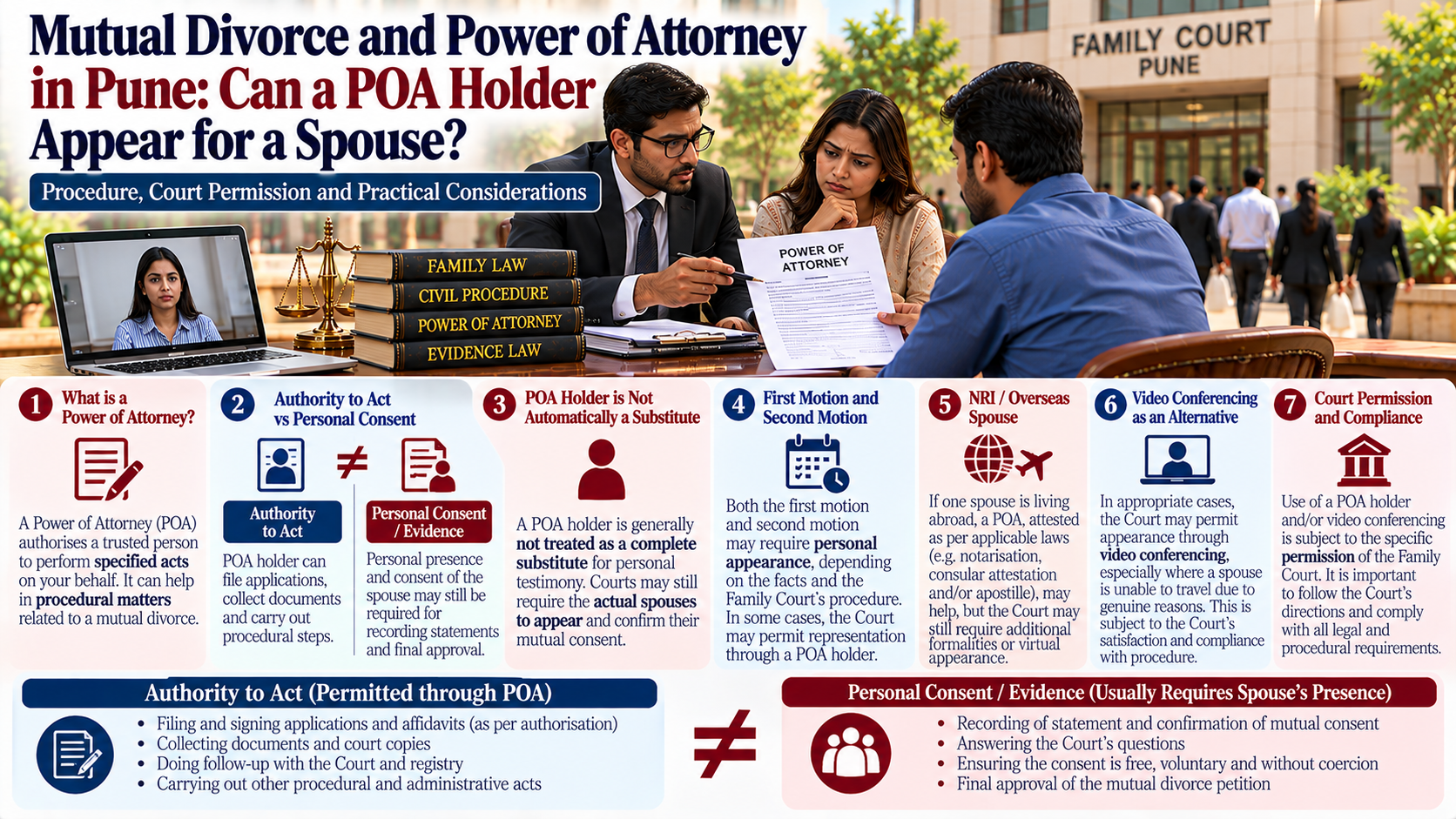
Spouses who are living in different cities or countries sometimes ask whether a Power of…

A marriage certificate is often treated as an important document when spouses approach a Family…
When parents decide to end their marriage by mutual consent, the divorce settlement usually addresses…
