Businesses sometimes discover that the same word or logo is already registered by another business, but in a different trademark class. Does the existence of an earlier registration automatically prevent a second business from using or registering that mark? Not always. Trademark protection in India is linked to the mark, the goods or services covered, the relevant legal tests and the facts of use. However, choosing a different class is not a guaranteed workaround for a conflict.
1. Why trademarks are registered in classes
Trademark applications specify the goods and/or services for which protection is sought. India’s classification system follows the Nice Classification, with Classes 1–34 generally covering goods and Classes 35–45 covering services. The class helps define the scope of an application and registration, but it is not a rigid wall that determines whether two businesses can safely use identical branding.
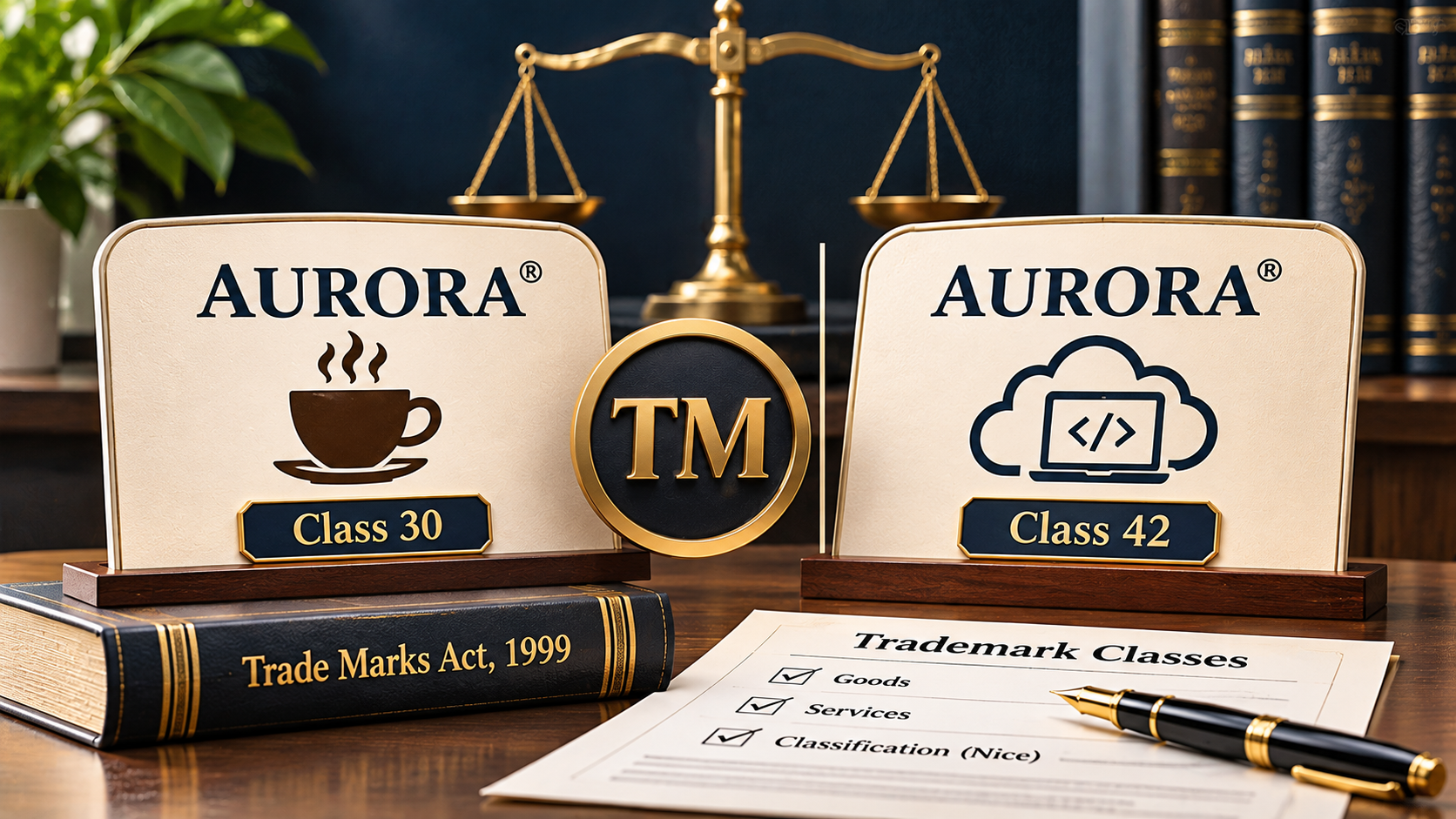
For example, a mark used for packaged coffee may be filed in Class 30, while a software service may fall in Class 42. The fact that the applications are in different classes is relevant, but the actual products and services, trade channels, consumers, brand reputation and possible association must still be considered.
2. Can the same trademark be registered in different classes?
In principle, identical marks can coexist in registrations where the goods or services are sufficiently different and the legal grounds for refusal do not apply. The Trade Marks Act does not make every identical word unavailable across all classes. The Registrar examines the application in the context of the earlier mark, the relevant goods or services and statutory provisions.
But “different class” does not necessarily mean “different goods or services.” Goods and services in separate classes may be commercially related, complementary, sold through similar channels, or commonly offered by the same businesses. Class numbers are administrative classification aids; the description and commercial relationship are important.
3. Section 11: the main conflict analysis
Section 11(1) of the Trade Marks Act, 1999 addresses earlier marks. A mark may be refused where it is identical to an earlier mark and the goods or services are similar, or where it is similar to an earlier mark and the goods or services are identical or similar, if there is a likelihood of confusion or association in the public’s mind. The inquiry is not limited to whether the class numbers match.
Section 11(2) also addresses identical or similar marks for dissimilar goods or services where the earlier mark is a well-known trademark in India and the later use without due cause would take unfair advantage of, or harm, its distinctive character or reputation. This is an important exception to the assumption that dissimilar classes always permit registration.
Accordingly, a business considering a mark already registered in another class should assess the earlier mark’s strength, reputation, goods/services descriptions and potential association. Search results should be examined rather than treated as a simple list of class numbers.
4. Examples: different classes, but possible commercial connection
- Example A — coffee and coffee shop: A mark registered for packaged coffee in Class 30 may be relevant to a later application for café services in Class 43. Consumers may believe the café is operated by, sponsored by or connected with the coffee brand.
- Example B — clothing and retail services: A mark for apparel in Class 25 and a similar mark for retail services in Class 35 can be commercially related because retail services may feature the branded products.
- Example C — software and electronics: A mark for downloadable software in Class 9 and software development or SaaS services in Class 42 may overlap in consumer expectations or business identity.
- Example D — unrelated industrial and entertainment products: Identical marks for highly unrelated goods may have a stronger coexistence argument, depending on the evidence, reputation and other statutory considerations.
These are illustrative only. Actual classification and conflict assessment depends on the goods/services specification, evidence and circumstances.
5. Does Section 12 allow coexistence?
Section 12 of the Act permits the Registrar, in cases of honest concurrent use or other special circumstances, to allow registration by more than one proprietor of identical or similar marks for the same or similar goods/services, subject to conditions and limitations considered appropriate. It is a statutory discretion and not an automatic entitlement.
Applicants relying on concurrent use should be ready to explain the history, honesty, extent and geography of use, the parties’ conduct, the likelihood of confusion and why coexistence conditions can manage the risk. Evidence and the particular circumstances matter.
6. Separate class filing is not a clearance strategy
A common mistake is to find an identical mark in another class and assume it is safe to file. A proper search should review the earlier mark’s full specification, status, proprietor, filing/priority date, use claim, device/word elements and any limitations. Check related classes and market use as well. A mark may be used beyond the class wording or have a reputation that is relevant to other goods/services.
Also check whether the earlier registration is live, whether applications are pending, and whether there are oppositions, rectifications or other proceedings. Search for similar spellings, phonetic equivalents, transliterations and device marks—not just the exact word.
7. Practical steps before filing
- Define your actual goods/services precisely, including the business model and planned expansion.
- Identify the appropriate Nice classes; do not choose a class only to avoid a search result.
- Search identical, similar, phonetic and device marks across relevant classes.
- Read the earlier mark’s full specification and record its status and dates.
- Assess commercial proximity, channels, consumers, complementary goods/services and possible brand association.
- Investigate whether the earlier mark is reputed or claimed as well-known.
- Consider whether a distinctive modification or a different brand would reduce risk.
- Document honest adoption, prior use, independent creation and other relevant facts.
- Obtain advice on whether coexistence, consent, limitation of specification or another strategy is appropriate.
- Review the application and prosecution record after filing; a Registry objection or third-party opposition may still arise.
8. Can the earlier owner stop a later application?
An earlier proprietor may raise an opposition under the applicable procedure if the later application is published and the statutory grounds are available. Depending on the facts, the proprietor may also consider other legal remedies. Registration in a different class does not by itself eliminate possible infringement or passing-off issues. The precise remedies and prospects depend on registrations, reputation, actual use, similarity and commercial context.
9. What should the applicant do if the Registry raises an objection?
Review the cited mark, the examiner’s reasoning and the goods/services comparison. A response should address the legal test and relevant facts rather than simply state that the classes differ. Where appropriate, explain the distinction in goods/services, market channels, consumer groups, mark differences and evidence supporting honest concurrent use or other special circumstances. Unsupported assertions of “different class” may not answer the objection.
10. Key takeaway
Two businesses may in some circumstances register or use the same trademark in different classes, but class separation alone is not a safe harbour. Sections 11 and 12, the nature of the goods/services, likelihood of confusion or association, reputation, honest concurrent use and evidence all matter. A trademark clearance decision should be based on the full commercial and legal picture, not only a class-number comparison.
Frequently Asked Questions
1. Can identical trademarks exist in different classes?
Yes, sometimes. Coexistence depends on the goods/services, conflict provisions, reputation and circumstances—not class numbers alone.
2. Does a different class guarantee registration?
No. Related goods/services or a well-known earlier mark may still create grounds for refusal.
3. What if one mark is for goods and the other for services?
Goods and services can be commercially related. Examine whether consumers could expect a common source or connection.
4. Can a famous mark block use in every class?
Section 11(2) provides protection for well-known marks against certain uses on dissimilar goods/services, subject to its legal requirements.
5. What is honest concurrent use?
It is a statutory basis under Section 12 for the Registrar to consider allowing multiple proprietors in qualifying circumstances, subject to conditions.
6. Is consent from the earlier trademark owner enough?
Consent may be relevant but does not automatically bind the Registrar or resolve every statutory issue. Its scope and wording should be carefully considered.
7. Should I search only the class I want to file in?
No. Search related classes, similar marks, phonetic equivalents and commercially connected goods/services.
8. Can I change my class after filing?
Specification changes are subject to statutory and procedural limits. Do not assume you can freely broaden or materially change the goods/services after filing.
9. Can an earlier proprietor oppose a later mark in another class?
They may oppose where legally available grounds apply, including relevant confusion, association or reputation grounds.
10. What is the safest approach before adopting an identical mark?
Conduct a full clearance search and evaluate specifications, market proximity, reputation, use and legal risks before adoption or filing.
Disclaimer
This article is for general informational purposes only and is not legal advice. Trademark outcomes depend on the facts, specifications, evidence and applicable law. Reading this article or contacting the website does not create an advocate-client relationship.
Official references: Trade Marks Act, 1999 (Sections 7, 11 and 12); IP India, Trade Marks Act and Trade Marks Rules resources; IP India Basics of Trademarks.
Post Views: 58