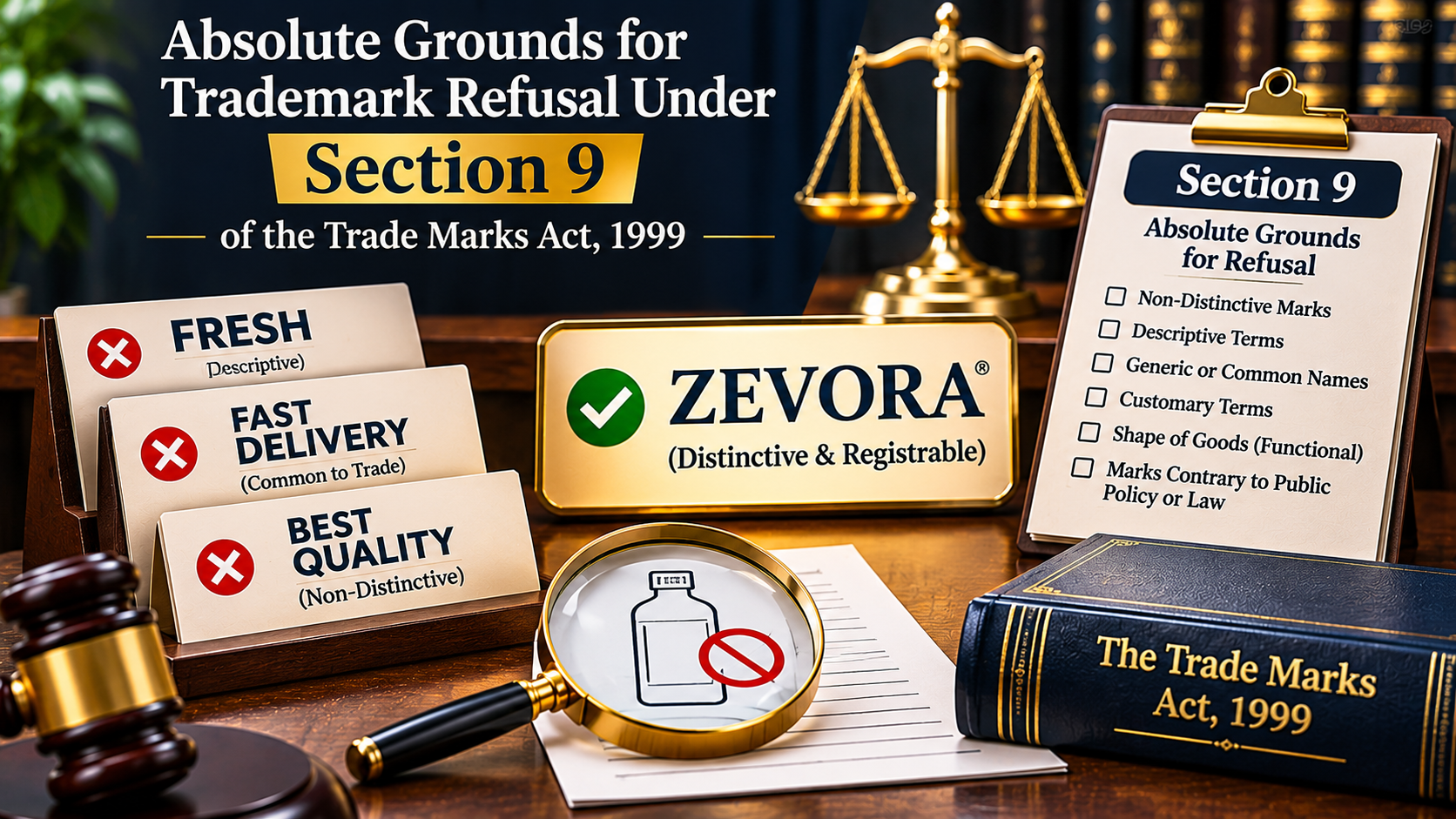
Section 9 of the Trade Marks Act, 1999 sets out absolute grounds on which a trademark application may be refused, even where the objection does not arise from an earlier registered mark. The focus is on the mark itself—its distinctiveness, descriptive or customary character, deceptive nature, prohibited content and certain product shapes. Understanding these grounds before filing can help businesses select a brand that is legally protectable and commercially sustainable.
1. What are absolute grounds for refusal?
Absolute grounds examine whether the proposed mark is suitable for trademark registration in its own right. They are different from relative grounds under Section 11, which principally address conflicts with earlier marks and other prior rights. A mark may face Section 9 objection even if no conflicting registration is found in the search.
2. Section 9(1)(a): Marks devoid of distinctive character
Section 9(1)(a) bars marks that cannot distinguish the goods or services of one person from those of another. A mark that is too ordinary, commonplace or incapable of functioning as a source identifier may be refused. Distinctiveness is assessed in relation to the mark and the relevant goods/services, and the perception of the relevant consumers may be important.
For example, a simple expression such as “FRESH” for fresh produce or “QUALITY” for a broad range of goods may be weak or non-distinctive in context. A distinctive invented word, unusual combination or original device may be stronger, subject to the facts and existing rights.
3. Section 9(1)(b): Descriptive marks
This provision addresses marks consisting exclusively of indications that may designate in trade the kind, quality, quantity, intended purpose, value, geographical origin, time of production or other characteristics of the goods or services. The issue is whether the expression primarily conveys information about the product or service rather than identifying a single commercial source.
Examples may include “SWEET” for confectionery, “FAST DELIVERY” for courier services, “COTTON” for cotton textiles or a place-name used descriptively for goods originating there. These are illustrative only; context, wording, presentation, relevant goods/services and evidence may change the assessment.
4. Section 9(1)(c): Customary or common trade expressions
Marks consisting exclusively of words or indications that have become customary in current language or in bona fide and established trade practices may be refused. A term commonly used by traders to describe or refer to a product or service may not be appropriate for exclusive source-identifying protection.
Applicants should consider whether the proposed term is commonly used by competitors, customers or the industry. A trade-specific term, abbreviation or expression may be customary in one market but distinctive in another, so the goods/services and relevant trade context matter.
5. Acquired distinctiveness: the proviso to Section 9(1)
The proviso allows a mark that would otherwise be caught by Section 9(1)(a), (b) or (c) to avoid refusal where, before the application date, it has acquired distinctive character through use or is a well-known trademark. Applicants relying on acquired distinctiveness should prepare evidence that demonstrates consumers have come to identify the mark with their commercial source.
Potential evidence may include dated sales invoices, advertising and marketing expenditure, market reach, consumer surveys where methodologically sound, press coverage, distribution records, product packaging, website history and declarations from customers or trade participants. Evidence must be credible, relevant, appropriately dated and tied to the mark and goods/services claimed. A large volume of documents is not automatically persuasive if the documents do not prove the relevant proposition.
6. Section 9(2): Deceptive marks, religious susceptibilities, scandalous or obscene matter and prohibited emblems
Section 9(2) covers additional public-interest and statutory restrictions. A mark may be refused if it is of such nature as to deceive the public or cause confusion; contains matter likely to hurt the religious susceptibilities of a class or section of citizens; comprises scandalous or obscene matter; or its use is prohibited under the Emblems and Names (Prevention of Improper Use) Act, 1950.
Applicants should assess whether a proposed name, symbol, image, wording or combination is misleading in its context, or falls within a protected or prohibited category. Where a mark incorporates a national symbol, official designation or protected emblem, the relevant legislation and restrictions must be examined before filing.
7. Section 9(3): Shape marks and functionality/value exclusions
Section 9(3) excludes marks consisting exclusively of certain shapes: a shape resulting from the nature of the goods themselves; a shape necessary to obtain a technical result; or a shape that gives substantial value to the goods. These provisions help prevent trademark registration from being used to obtain exclusive rights over features that are not appropriately protected as source identifiers.
For product-shape applications, consider whether the claimed shape is inherent in the product, dictated by function, or a major contributor to its aesthetic or commercial value. A shape mark should be evaluated carefully against the statutory exclusions and the evidence available.
8. Section 9 and the nature of goods/services
The explanation to Section 9 clarifies that the nature of the goods or services for which the mark is used or proposed to be used is not, by itself, a ground for refusal. This should not be confused with the other grounds in Section 9: a mark may still be non-distinctive, descriptive, customary, deceptive or otherwise prohibited.
9. How the Registry examines Section 9 objections
IP India’s trademark workflow identifies substantive examination under Sections 9, 11 and 13 and shows that objections may lead to an examination report, response, further review or hearing before acceptance or refusal. Applicants should read each objection individually, identify the statutory clause relied upon, and respond with focused submissions and evidence rather than generic arguments.
10. How to prepare a response to a Section 9 objection
- Identify the exact clause of Section 9 cited in the examination report.
- Assess the mark as a whole and in relation to the specified goods/services.
- Explain why the mark is distinctive, suggestive, coined or otherwise capable of identifying source, where supported.
- Address the examiner’s reasoning directly, not merely assert that the mark is unique.
- If relying on acquired distinctiveness, compile a chronology and supporting evidence predating the application.
- Consider limitations, disclaimers or other amendments only if legally and commercially appropriate.
- Observe the applicable response and hearing deadlines and retain filing proof.
11. Pre-filing checklist for Section 9 risk
- Does the mark distinguish the applicant’s goods/services from those of others?
- Is it exclusively descriptive of features, quality, kind, purpose, value or origin?
- Is it customary or commonly used in the relevant trade?
- Could it deceive consumers or contain prohibited content?
- Does it consist exclusively of a shape subject to Section 9(3)?
- Is any claim of acquired distinctiveness supported by evidence before the filing date?
- Has the mark been assessed in relation to the exact goods/services and relevant consumer perception?
Frequently Asked Questions
1. What is Section 9 of the Trade Marks Act?
Section 9 provides absolute grounds for refusal of trademark registration, including non-distinctive, descriptive or customary marks and specified public-interest, prohibited-content and shape-related grounds.
2. What is the difference between Section 9 and Section 11?
Section 9 examines the registrability of the mark itself under absolute grounds. Section 11 principally addresses earlier marks, rights and likelihood of confusion or other conflicts.
3. Can a descriptive trademark be registered in India?
It may be refused under Section 9(1)(b), but the proviso to Section 9(1) may apply where distinctiveness was acquired through use before the application date or the mark is well-known.
4. What does “devoid of distinctive character” mean?
It means the mark is not capable of distinguishing one trader’s goods/services from those of another in the relevant context.
5. Can common words be trademarked?
Common words can be registrable for goods/services where they function distinctively and are not descriptive or customary in that context. The assessment is context-specific.
6. How do I prove acquired distinctiveness?
Use reliable, dated evidence showing commercial use and consumer recognition, such as sales, advertising, market reach, press coverage and other relevant records, with the evidence linked to the mark and specification.
7. Can a product shape be registered?
Some shapes may be protectable, but Section 9(3) excludes certain shapes resulting from the nature of the goods, necessary for a technical result or giving substantial value.
8. Can a mark be refused because it is deceptive?
Yes. Section 9(2)(a) addresses marks of such nature as to deceive the public or cause confusion, subject to examination of the facts and context.
9. What happens after a Section 9 examination objection?
The applicant should submit a reasoned response with relevant evidence within the applicable deadline and attend a hearing if required. The Registry may accept, conditionally accept or refuse the application.
10. Does prior use automatically overcome Section 9?
No. The proviso requires acquired distinctiveness before the application date or the mark to be well-known. Evidence and the statutory ground must be carefully assessed.
Official references
Disclaimer
This article is for general informational purposes only and is not legal advice. Registrability depends on the mark, goods/services, evidence and the applicable statutory provisions. Reading this article or contacting the website does not create an advocate-client relationship.
Post Views: 63