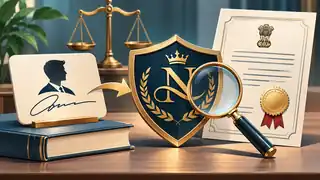
Can a personal name function as a trademark?
Yes. Indian trademark law recognises names as potential marks. Section 2(m) of the Trade Marks Act, 1999 includes a “name” and “signature” within the definition of a mark; Section 2(o) states that “name” includes an abbreviation. But the mark must still meet Section 2(zb): it must be capable of distinguishing one person’s goods or services from those of others and be graphically represented. A person’s legal name alone does not guarantee registration.
A name may identify a person socially but may not tell consumers that particular goods or services come from one commercial source. The applicant must consider distinctiveness, goods/services, earlier marks, actual use and any third-party consent or rights.
Which names or personal brands may be protected?
Potential marks include a full name, surname, initials, stage name, pen name, professional pseudonym, signature, monogram or a distinctive personal-brand name. A musician may use a stage name for recordings and performances; a chef for restaurants or packaged food; a consultant for professional services; or an influencer for merchandise. In each case, the name should function as a commercial source identifier.
A word-mark application for a name differs from a stylised signature, portrait, monogram or combined name-and-logo device mark. These are different representations and may require separate filing strategies. Rights are tied to the mark and goods/services covered; registration in one class does not protect every business activity. For class selection, see How to Choose the Correct Trademark Class for Your Business in India and the 45-class guide.
Distinctiveness and common names
Section 9(1) bars marks that lack distinctive character, are exclusively descriptive of relevant characteristics, or have become customary in the trade. Its proviso allows a mark that acquired distinctiveness through use before filing, or is a well-known mark, to overcome the relevant Section 9(1) objection.
Common first names and surnames can be difficult to monopolise because others may legitimately have the same name. An uncommon surname, coined name, or personal name consistently used in a distinctive commercial context may be stronger. The Registrar considers the mark as a whole and the relevant goods/services; there is no blanket rule that all common surnames are prohibited.
If a name is weak alone, a distinctive logo or composite mark may help, but a composite registration does not necessarily confer exclusive rights over every non-distinctive element separately. Section 17 generally limits exclusive rights to the mark taken as a whole, subject to the Act.
Using another person’s name: consent and association
Using your own name differs from using another person’s name, signature or likeness in a way that suggests endorsement. Section 14 applies where a mark falsely suggests a connection with a living person or a person who died within twenty years before the application. The Registrar may require written consent from that person or the deceased person’s legal representative and may refuse to proceed without it.
Rule 29 of the Trade Marks Rules, 2017 also deals with names and representations of living persons or persons recently dead. Where a person’s name or representation appears on a mark, the Registrar may require written consent. This is important when a mark includes a celebrity, public figure or someone whose identity could imply a connection that does not exist. Check the rule and Registry requirements for the particular application.
Permission for a photo, campaign, endorsement, event or social-media post should not be assumed to be permission to register the name as a trademark or use it for unrelated products. Keep consent specific and in writing.
Can a surname be registered even if others use it?
Possibly. The applicant must establish a registrable mark and consider the surname’s commonness, earlier registrations, marketplace use and likelihood of objection or opposition. A surname registration may have limited practical scope where the word is common or others have legitimate rights.
Section 35 protects bona fide use of a person’s own name, place of business or a predecessor’s name, and bona fide descriptions of goods or services. It is not a licence to imitate another trader or intentionally create confusion. Courts examine honesty, context, presentation and evidence.
In Precious Jewels & Anr. v. Varun Gems, Civil Appeal No. 7191 of 2014, decided 4 August 2014, the Supreme Court set aside an interim restraint against family members using their surname “Rakyan” in the jewellery trade. It expressly limited its observations to a prima facie interlocutory view and left final adjudication to evidence.
In M/s Varun Gems v. M/s Precious Jewels & Anr., RFA(OS)(COMM) 6/2019 (6 October 2022), the Delhi High Court granted an injunction against use of “RAKYAN” or similar marks within two kilometres of the plaintiff’s jewellery premises. It found the defendants’ use was not bona fide on the uncontroverted evidence: their shop had changed from “DIAMEZ” to “NEENA & RAVI RAKYAN” and was next door to the plaintiff’s business. The decision illustrates that a surname defence can fail where the circumstances show likely confusion or an attempt to benefit from another mark’s goodwill.
In Jangeer Singh Trading v. Yogesh Jangid Trading, CS(COMM) 598/2022, judgment dated 11 March 2025, the Delhi High Court considered similar marks in agricultural implements and surname-based bona fide use. At the interim stage, it accepted the defendant’s bona fide surname use based on earlier family-business records and found the device marks visually dissimilar. It barred “JANGIR” and “JANGEER” and stand-alone “JANGID”, but permitted the registered device mark in its registered form. The observations were expressly interim.
Who should own the trademark?
A personal-name mark is not automatically a company asset merely because the company uses it. Document any transfer and consider licensing, quality control and succession.
Practical pre-filing checklist
- Select the mark: full name, surname, initials, stage name, signature, logo or combination; keep the representation consistent.
- Search earlier marks: check exact, phonetic and visual similarities in relevant classes. See the search report guide.
- Choose classes: identify the goods/services the name will brand; avoid filing for unrelated categories without a basis.
- Assess distinctiveness: if relying on acquired recognition, collect evidence predating filing.
- Check consent: where another person’s name or likeness appears, assess Section 14, Rule 29 and other applicable rights.
- Preserve genuine records: invoices, dated advertisements, web/social-media records, labels, sales and promotion evidence can help prove use.
- File and monitor: accurately state owner, mark, class, specification and use claim; monitor examination, publication and Registry notices.
Frequently asked questions
1. Can I trademark my own name in India?
Yes, if the name functions as a mark and meets statutory requirements, including distinctiveness and conflict checks for the relevant goods/services.
2. Can I register only my surname?
Potentially. Common surnames may be weak or contested; the outcome depends on the mark, earlier rights, use and evidence.
3. Is a common first name automatically refused?
No. The Registrar assesses registrability and distinctiveness in context; there is no automatic ban on all first names.
4. Can I trademark a stage name or pen name?
Yes, if it identifies commercial goods or services and meets the Act’s requirements.
5. Can a company register its founder’s name?
It may be possible, but ownership, authority, right to use and consent where relevant should be documented.
6. Do I need consent to register my own name?
Consent concerns generally arise where the mark suggests a connection with another person or where the Registrar requires it under Section 14 or Rule 29. Check the facts and current Registry requirements.
7. Can I register a celebrity’s name without permission?
That may be risky. Section 14 and Rule 29 may require consent, and other rights or claims may apply. Do not assume a name is free for commercial use.
8. Does registration stop everyone with the same surname?
No. Rights are limited by the Act and registration; Section 35 protects bona fide own-name use in qualifying circumstances.
9. What evidence helps show my name has become a brand?
Invoices, dated advertising, publicity, web/social records, sales and recognition evidence may help, depending on what must be proved.
10. Can I transfer my personal-name trademark to my company later?
A transfer may be possible through a documented transaction and applicable recordal procedures. Plan ownership and check current requirements before transferring.
Official sources and judgments
- Trade Marks Act, 1999 — IP India (Sections 2, 9, 14, 18, 28, 29 and 35)
- Trade Marks Rules, 2017 — IP India (including Rule 29)
- Precious Jewels & Anr. v. Varun Gems — Supreme Court, 4 August 2014 (judgment reproduction)
- M/s Varun Gems v. M/s Precious Jewels & Anr. — Delhi High Court, 6 October 2022 (judgment reproduction)
- Jangeer Singh Trading v. Yogesh Jangid Trading — Delhi High Court, 11 March 2025, 2025:DHC:1587 (official judgment)
Disclaimer: This article is general legal information and education, not legal advice. It is not a substitute for advice based on a particular matter. No advocate-client relationship is created by reading, accessing or using this article.
Post Views: 73