Legal position reviewed as at 11 November 2026.
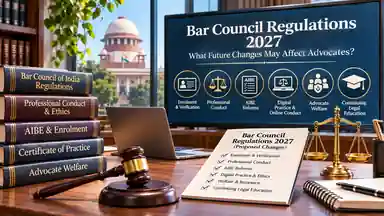
Bar Council regulation in India is not governed by one new “2027 code”. Advocates remain subject to the Advocates Act, 1961, Bar Council of India (BCI) Rules, State Bar Council rules, Gazette notifications, BCI directions and binding court orders. Several 2025–2026 developments on digital ethics, elections and foreign-lawyer discipline will remain relevant in 2027.
1. How Bar Council rules are made
Section 49 empowers the BCI to frame rules on professional conduct, legal education, disciplinary procedure and other statutory matters. Rules under Section 49(1)(c) on professional conduct and Section 49(1)(gg) on dress require the Chief Justice of India’s approval. State Bar Councils may frame rules under Section 15 for matters such as elections and Council administration, but Section 15(3) requires BCI approval before those rules take effect. Section 48B separately permits the BCI to issue supervisory directions to State Bar Councils.
A Gazette rule, BCI direction and administrative circular have different legal status. Identify the source and authority of a requirement before treating it as a new offence or obligation. Read the Advocates Act, 1961 on India Code.
2. Professional conduct and the digital-ethics circular
Part VI, Chapter II of the BCI Rules sets standards of professional conduct and etiquette, including duties to the Court, clients, opponents, colleagues and the profession. Confidentiality, dignity towards the Court and restrictions on solicitation and advertising apply online as well as in conventional practice.
On 17 July 2026, the BCI issued Circular BCI:D:4657/2026 on social-media conduct, digital ethics, Court decorum, confidentiality and professional responsibility for advocates, law students and interns. Implementation letter BCI/D/4659/2026 directed immediate implementation by State Bar Councils and Centres of Legal Education.
The directions address misuse of Court premises, judicial and live-streamed proceedings, professional identity, client and chamber material, misleading legal content, AI-generated material, deepfakes and voice-cloned audio. Law colleges are directed to hold sensitisation sessions, obtain student undertakings at admission and before internships, designate a nodal officer or monitoring group and preserve implementation records. State Bar Councils are directed to circulate the circular to advocates and Bar Associations, establish a Digital Ethics Committee or nodal mechanism and complaint channel, and report implementation.
The implementation letter requires preventive and proportionate action consistent with the Advocates Act, BCI Rules, Court rules and natural justice; it cautions against personal rivalry, moral policing, suppression of lawful criticism and action on unverified allegations. The circular does not replace Part VI, Chapter II by Gazette amendment and is not a blanket ban on social media. See BCI notifications and the Bar Council of Kerala page hosting the circular and implementation letter.
3. Courtroom recordings: Supreme Court interim order
In Harshita Grover v. Union of India, W.P.(C) No. 751 of 2026, the Supreme Court’s interim order dated 24 July 2026 restrained extraction, dissemination, monetisation, posting, uploading, editing, storing or hosting audio-video recordings of judicial proceedings on digital platforms without prior permission of the Supreme Court Secretary General or the Registrar General of the jurisdictional High Court.
A 31 July clarification allowed recognised news outlets to report on proceedings but not to use audio or video clips. At the 30 October 2026 hearing, the Court recorded that MeitY’s proposed policy was under consideration and that measures against non-compliance would be incorporated. No final nationwide policy was identified as at 11 November 2026. Advocates should obtain permission before extracting, editing or uploading hearing footage.
Read the 24 July interim order; see the 31 July clarification report and 30 October hearing report.
4. Bar Council election rules amended in April 2026
The BCI amended Chapter III of its Uniform Rules and Mandatory Guidelines for Elections of Bar Councils, 2016 by notification dated 21 April 2026, published in the Gazette of India, Extraordinary, No. 280 dated 22 April 2026. The Supreme Court approved the amendment on 20 April 2026 and directed Gazette publication.
A Bar Association office-bearer may contest a State Bar Council election after filing an undertaking with the Returning Officer at nomination. If elected, the advocate must, within 15 days of declaration of results, give a written option to retain only one representative post and notify both bodies. Failure to do so results in deemed vacation of State Bar Council membership. The amendment applies where elections had not yet been held when it came into force; check any election-specific supervisory directions.
Read Gazette No. 280 dated 22 April 2026 and the Supreme Court order dated 20 April 2026.
5. Foreign lawyers and law firms
The BCI Rules for Registration and Regulation of Foreign Lawyers and Foreign Law Firms in India, 2022 were amended by Gazette notification published on 13 May 2025. The amendment introduced Chapter V on disciplinary issues and penalties. Rules 10 and 11 provide a specialised process for registered foreign lawyers and firms, subject to applicable professional and ethical standards. Indian firms should verify registration, reciprocity and permitted scope before structuring cross-border legal engagements. See the BCI’s official rules material.
6. AIBE, enrolment and Certificate of Practice
The BCI notifications page carries cycle-specific material, including the AIBE-XXII syllabus and Certificate of Practice updates for earlier examination cycles. Law graduates should preserve degree, enrolment and examination records. Advocates should keep State roll and practice particulars current and follow the latest official AIBE, verification and Certificate of Practice notice. Do not assume a blanket AIBE timetable or new Certificate of Practice requirement for every advocate in 2027 without a specific notification.
7. What may change in 2027?
As at 11 November 2026, no consolidated national instrument titled “Bar Council Regulations 2027” or fixed 2027 commencement package was identified in the official sources reviewed. The draft Advocates (Amendment) Bill, 2026 was a separate consultation exercise and is not an enacted law or an operative set of BCI Rules.
Practical analysis, not confirmed Government policy: advocates should monitor further directions or formal rule changes on digital and AI-assisted communication, practice verification, AIBE and Certificate of Practice, election administration, continuing legal education and cross-border practice. A new obligation must be traced to an enacted amendment, approved and notified rule, statutory BCI direction, State Bar Council rule or binding court order.
8. What advocates and institutions should do now
- Advocates: review online profiles, advertising, confidentiality controls and use of Court footage against current rules and orders.
- Chambers: adopt written protocols for interns, AI-assisted content, client files, social-media access and approval of public commentary.
- Bar Associations: update election records and brief office-bearers on the nomination undertaking and 15-day option.
- Law colleges: conduct sensitisation, collect admission and internship undertakings, designate a nodal officer and preserve implementation records.
- Cross-border practices: verify foreign-lawyer registration, reciprocity, permitted work and disciplinary requirements.
9. Existing framework and 2027 watchpoints
| Area |
Position on 11 November 2026 |
2027 watchpoint |
| Professional conduct |
Part VI, Chapter II of BCI Rules; July 2026 digital-ethics circular. |
Further BCI directions or formal rule amendment. |
| Bar Council elections |
2016 election rules amended by Gazette publication on 22 April 2026. |
State election notices and 15-day option compliance. |
| Court recordings |
Supreme Court interim order of 24 July 2026 and 31 July clarification. |
Final MeitY policy or further Court order. |
| Foreign lawyers |
2022 registration rules amended on 13 May 2025, with disciplinary provisions. |
Registration, reciprocity and scope-of-practice directions. |
| AIBE / Certificate of Practice |
Cycle-specific BCI notifications. |
New syllabus, examination and verification notices. |
Frequently asked questions
1. Have Bar Council Regulations 2027 been notified?
No consolidated national instrument by that title was identified as at 11 November 2026. Existing Acts, rules, notifications, circulars and court orders continue to apply according to their legal status.
2. Which provisions empower the BCI to frame rules?
Section 49 of the Advocates Act empowers BCI rule-making; Section 15 governs State Bar Council rules, which require BCI approval.
3. Are the July 2026 digital-ethics directions a Gazette amendment?
No. They are BCI circular and implementation directions; they do not replace Part VI, Chapter II by Gazette amendment.
4. Is social media completely prohibited for advocates?
No blanket ban should be inferred. Advocates must comply with duties concerning dignity, confidentiality, solicitation, accuracy and Court decorum.
5. Can advocates upload clips from hearings?
The Supreme Court’s interim order requires prior permission for specified use of audio-video recordings on digital platforms. Check the latest order before using a clip.
6. Can a Bar Association office-bearer contest a State Bar Council election?
Yes, subject to the prescribed undertaking and, if elected, choosing only one representative post within 15 days of declaration of results.
7. Do foreign-lawyer rules regulate Indian advocates?
They principally regulate registered foreign lawyers and firms. Indian advocates should verify registration and permitted scope when structuring cross-border work.
8. Will AIBE rules change in 2027?
Only a specific BCI notification can confirm a syllabus, schedule or eligibility change.
9. Where should advocates check current updates?
Check BCI notifications and rules, the Gazette of India, India Code, the relevant State Bar Council and binding Court orders.
Related reading
Download: Bar Council Regulations 2027 – Advocate Compliance Checklist (PDF). This is a monitoring aid, not a statutory form or legal certificate.
Disclaimer: General legal information only. Check the current Act, BCI and State Bar Council rules, Gazette notifications and binding Court orders before acting on a specific disciplinary, election, enrolment or practice issue.
Post Views: 680