
Divorce Law in India: Grounds, Procedure, Maintenance…
Important Disclaimer This article is provided solely for general legal information and public awareness. It…
EXCELLENT Based on 66 reviews
 Posted on Google
 Nabeel AkhtarFacing a criminal case can be stressful, but Advocate Nikhil Rathod made the entire process manageable. His strategic approach and strong representation gave me great relief.Posted on Google
 Srinath KarliAn experienced and sharp lawyer. Truly fast and great precise advocacy services offered. Highly recommended! Thankyou.Posted on Google
 SHIVA GAIKWAD
Trustindex verifies that the original source of the review is Google.
Good experience 👍👍👍👍Posted on Google Mangesh LawandeBest advocate for getting justice in Pune he is a very kind by nature 😊✨💫
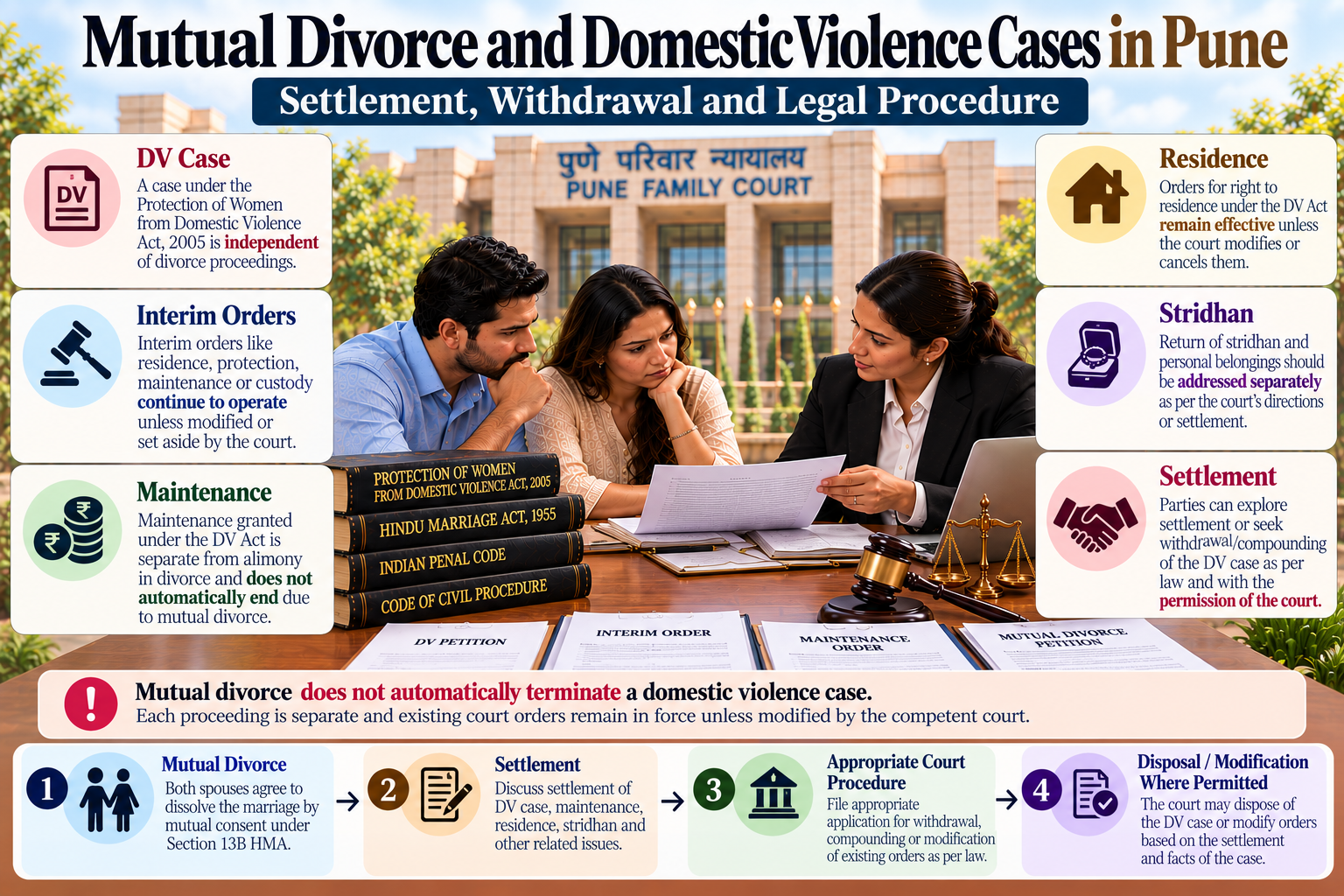
Mutual divorce and proceedings under the Protection of Women from Domestic Violence Act, 2005 may exist at the same time. A spouse may be pursuing or defending a domestic violence case while the parties are negotiating a settlement and considering divorce by mutual consent under Section 13B of the Hindu Marriage Act, 1955.
A mutual divorce settlement can address domestic violence proceedings, but the divorce petition and the domestic violence case remain legally distinct proceedings. Obtaining a decree of mutual consent divorce does not, by itself, automatically erase every order or proceeding under the Domestic Violence Act. The settlement should therefore identify the pending case, the reliefs involved, the agreed obligations and the procedural steps required to bring the dispute to an appropriate conclusion.
No. A decree of divorce by mutual consent does not automatically operate as an order disposing of every proceeding under the Domestic Violence Act. The effect of the settlement depends on the nature and stage of the domestic violence proceeding, orders already passed, reliefs granted, and the procedure followed before the competent court.
If a domestic violence application is pending, the parties may record a settlement and take the appropriate procedural steps before the court dealing with that proceeding. If an interim or final order has already been passed, the settlement should specifically address that order rather than merely stating that “all cases are withdrawn.”
A carefully drafted settlement may address the parties’ agreement concerning maintenance, residence, monetary relief, return of stridhan, jewellery and personal belongings, child-related expenses, property, pending complaints and other matrimonial disputes. It should also state the procedural steps each party will take in relation to the pending domestic violence case.
The settlement should identify the DV case number, court, parties and present stage. Where an interim protection, residence, monetary or other order exists, the settlement should refer to it specifically and explain the intended legal course.
A mutual divorce petition concerns dissolution of the marriage under the applicable matrimonial law. A domestic violence proceeding concerns statutory reliefs arising from allegations and circumstances covered by the Domestic Violence Act. The two proceedings may arise from the same matrimonial relationship, but they are not identical.
A settlement can coordinate both matters. However, the court dealing with the DV proceeding may still need to pass an appropriate order before the proceeding is formally disposed of or modified.
The appropriate procedure depends upon whether the matter is a complaint/application before the Magistrate, an appeal, an execution proceeding, or another stage. A settlement may provide for the applicant to take appropriate steps for withdrawal or disposal, but the exact procedure should be followed before the competent court.
Parties should avoid drafting an absolute clause stating that the DV case is automatically cancelled on the date of divorce. The settlement should instead record the agreed cooperation and the procedural steps necessary for disposal.
If an interim monetary-relief or maintenance order is already in force, the settlement should specifically state how arrears, future payments and the existing order will be addressed. The parties should not assume that the order disappears merely because they have signed a settlement agreement.
If the parties agree upon a lump-sum amount as full and final settlement of specified financial claims, the settlement should clearly state the claims covered, the payment schedule and the procedural steps concerning the existing proceeding and orders.
Residence-related issues should be dealt with expressly where a DV proceeding contains a residence claim or order. If the wife or children are occupying a jointly used or disputed residence, the settlement should identify the proposed arrangement, the date of possession or vacating, alternative accommodation where agreed, and responsibility for rent or housing expenses.
A property settlement and a residence arrangement are not always the same thing. Ownership, possession and residence rights should therefore be addressed separately.
If a protection order or other interim order has been passed, the settlement should identify it. The parties should then follow the procedure required to seek modification, discharge, disposal or other appropriate relief before the competent court.
A private settlement should not be treated as though it silently overrides a judicial order. Until the competent court passes an appropriate order, parties should remain mindful of the operative court directions.
Stridhan and jewellery should be listed specifically in the settlement if their return or financial value is part of the resolution. The settlement should identify what is being returned, when and how delivery will occur, and whether any agreed monetary payment is being made in lieu of particular items.
Proof of delivery, acknowledgment, photographs, inventory and payment records may be preserved where appropriate. A vague clause stating that “all articles have been returned” may create avoidable disputes if the parties later disagree about what was actually delivered.
Mediation can be useful where the parties are willing to resolve the underlying matrimonial disputes consensually and where the subject matter is legally capable of settlement. The mediator can assist the parties in identifying financial, property, child-related and procedural terms.
The Supreme Court has continued to emphasise mediation and consensual resolution in family disputes. In September 2026, the Supreme Court highlighted domestic violence, marriage and divorce, custody, shared parenting, visitation, maintenance, alimony and property division among issues considered in its regional conference on ADR and adjudication in family disputes. This reflects the institutional importance of appropriate consensual dispute resolution, but it does not make mediation mandatory in every DV or divorce case.
Recent Supreme Court orders show that matrimonial settlements can sometimes encompass divorce, financial claims and connected proceedings. In an order dated 11 February 2026, the Supreme Court recorded a joint request by spouses seeking mutual divorce and quashing of pending cases, with the parties appearing through video conferencing and a full-and-final financial settlement forming part of the arrangement. The Court’s treatment was based on the particular proceedings and settlement before it.
In another Supreme Court settlement recorded in May 2026, the parties agreed to resolve matrimonial claims through a detailed settlement covering permanent alimony, stridhan and other financial issues, with specified payment arrangements. The example demonstrates the value of precise settlement terms, but it does not create a fixed formula for every matrimonial or DV dispute.
The Supreme Court has also recorded settlements in which parties agreed to cooperate for the quashing or withdrawal of pending criminal and civil proceedings connected with matrimonial disputes. Such cases demonstrate that a comprehensive settlement can provide a coordinated framework, but the appropriate court procedure remains necessary for each proceeding.
The availability and procedure for quashing depend upon the nature of the proceeding, the statutory framework, the stage of the case and the jurisdiction invoked. A genuine matrimonial settlement may be relevant to a High Court’s consideration in an appropriate case, but settlement does not create an automatic entitlement to quashing.
Parties should also distinguish a proceeding under the Domestic Violence Act from an FIR or prosecution under criminal law. Different legal procedures may apply even when all matters arise from the same matrimonial dispute.
If a DV proceeding exists alongside an FIR or criminal prosecution, the settlement should identify each matter separately. The parties should state what cooperation is expected in each proceeding and avoid using one broad clause that assumes all cases will automatically terminate together.
The legal route for an FIR, charge-sheeted prosecution, private complaint, DV proceeding and maintenance case can differ. The settlement should therefore function as a coordinated record of obligations rather than as a substitute for the orders required in each court.
Where minor children are involved, the settlement should separately address custody, residence, visitation, education, medical expenses, travel, insurance and other child-related arrangements. The child’s welfare remains an important consideration, and the parents’ settlement should not be drafted as though the child were merely part of the spouses’ financial bargain.
If the child is living with one parent in a residence that is the subject of the DV case, the settlement should coordinate the child’s residence arrangement with the property and residence provisions.
Parties may record commitments concerning future disputes arising from the same settled matrimonial issues, but such clauses should be drafted carefully. A private agreement cannot lawfully prevent a person from exercising a statutory right that cannot be contracted away, and the effect of a broad “no complaint” clause depends upon the nature of the right and proceeding involved.
A better drafting approach is to identify the disputes actually being settled and state the parties’ undertakings concerning those disputes without attempting to contract out of mandatory law.
The settlement should state the sequence of reciprocal obligations. For example, if a lump-sum payment is to be made in instalments, the agreement should identify the amount and due date of each instalment and the corresponding procedural step, if any.
Where the parties have already completed part of the settlement, the agreement should record the completed obligations accurately rather than restating them as future promises.
Parties may agree to resolve specified personal maintenance and financial claims, subject to the applicable law and existing court orders. The drafting should identify whether the settlement covers past, present and future claims and whether it concerns only the spouses or also addresses child-related expenses.
Child support should be separately addressed. A clause settling the spouses’ personal maintenance should not be assumed to eliminate a minor child’s independent legal interests.
Before finalising a mutual divorce settlement where a DV case is pending in Pune, the parties should prepare a litigation chart identifying the DV case number, court, stage, interim orders, next date, monetary relief, residence issues and agreed procedural action.
The settlement should then be checked against the actual court record. If an order is already in force, the parties should identify the application or proceeding required to modify or dispose of it. If criminal or maintenance proceedings are also pending, each should be separately identified and addressed.
No. The DV proceeding should be dealt with through the appropriate legal procedure and court order.
The parties may negotiate a comprehensive settlement covering the matrimonial disputes, subject to applicable law and the procedure required for the pending DV proceeding.
The appropriate procedural step depends on the stage and nature of the proceeding. The settlement should specify the agreed action.
The existing order should be specifically addressed and, where necessary, appropriate relief should be sought before the competent court.
Parties may settle financial claims subject to applicable law and existing orders. The settlement should clearly address arrears, future claims and payment terms.
A protection order should not be assumed to disappear automatically. The competent court should be approached for the appropriate procedural order where required.
In an appropriate case, the High Court may consider quashing proceedings according to its jurisdiction and applicable legal principles, but settlement does not create an automatic right to quashing.
The settlement should specifically address residence, possession, property ownership and any agreed alternative housing arrangement.
Yes. The settlement can specify return of identified articles or an agreed monetary arrangement, with appropriate documentation.
Each proceeding should be separately identified and dealt with through the legally applicable procedure.
The parties may record appropriate settlement undertakings concerning disputes already resolved, but an agreement cannot automatically extinguish every statutory right or prevent lawful recourse in every future circumstance.
The settlement records the parties’ agreement, but the pending proceeding may still require an appropriate court order.
The Family Court’s jurisdiction should not be confused with the jurisdiction of the court dealing with the DV proceeding. The correct forum depends on the proceeding and relief involved.
A settlement can address the proceeding, but the appropriate court in which it is pending may still need to pass the relevant order.
Mediation may assist in resolving legally suitable family disputes, but it does not replace any mandatory court procedure.
The agreement should state each instalment, due date, payment method, proof of payment and the corresponding obligations of the parties.
Child-related financial arrangements require separate consideration and remain subject to the child’s legal interests and applicable law.
The available remedy depends on the terms of the settlement, orders already passed and the nature of the breach.
Yes. Identifying the case number, court and stage helps prevent ambiguity and facilitates the appropriate procedural steps.
The central point is to treat the mutual divorce and DV proceeding as coordinated but legally distinct matters, with clear settlement terms and the correct court procedure for each.
Important Disclaimer
This article is provided solely for general legal information and public awareness. It is not legal advice, legal opinion, or a legal solution to any specific facts or circumstances. Laws and their interpretation may change, and the application of law depends upon the facts of each individual matter. Readers should not rely upon this article as a substitute for obtaining appropriate legal advice concerning their specific circumstances. Nothing contained in this article creates, establishes or constitutes an advocate-client relationship between the reader and Trident Legal Services, Advocate Nikhil Rathod, or any other person associated with the publication.
+91 820 890 9423
desk@tridentlegal.in
Flat No. 302, Kalunkhe Niwas, Khopade Nagar, Gujaewadi, Katraj, Pune - 411041


I was really impressed with Trident Legal and Advocate Nikhil Rathod. Even though they just started,
Trident Legal and Advocate Nikhil Rathod are really good at what they do. Even though they
I had a great experience with Trident Legal and Advocate Nikhil Rathod. Even though they are
Trident Legal, with Advocate Nikhil Rathod, is like a rising star in the legal world. I
I was lucky to work with Trident Legal and Advocate Nikhil Rathod. Even though they just
Trident Legal and Advocate Nikhil Rathod are really amazing! They helped me with legal stuff and
Trident Legal and Advocate Nikhil Rathod are like superheroes! They are really good at legal stuff
I wasn’t sure about Trident Legal because they are new, but they surprised me! Advocate Nikhil
I had the honor of working with Trident Legal and Advocate Nikhil Rathod. They were really
Trident Legal, led by Advocate Nikhil Rathod, is like a superhero in the legal world. Even

Important Disclaimer This article is provided solely for general legal information and public awareness. It…
When spouses decide to seek divorce by mutual consent, arrangements for their children often require…
When a marriage involves an Indian citizen, an Overseas Citizen of India (OCI) cardholder or…
Indian couples living or working abroad sometimes obtain a divorce decree from a foreign court…
When parents agree to a mutual divorce, arrangements for their minor child may extend beyond…
Spouses may hold assets in more than one country. A couple filing for mutual divorce…
