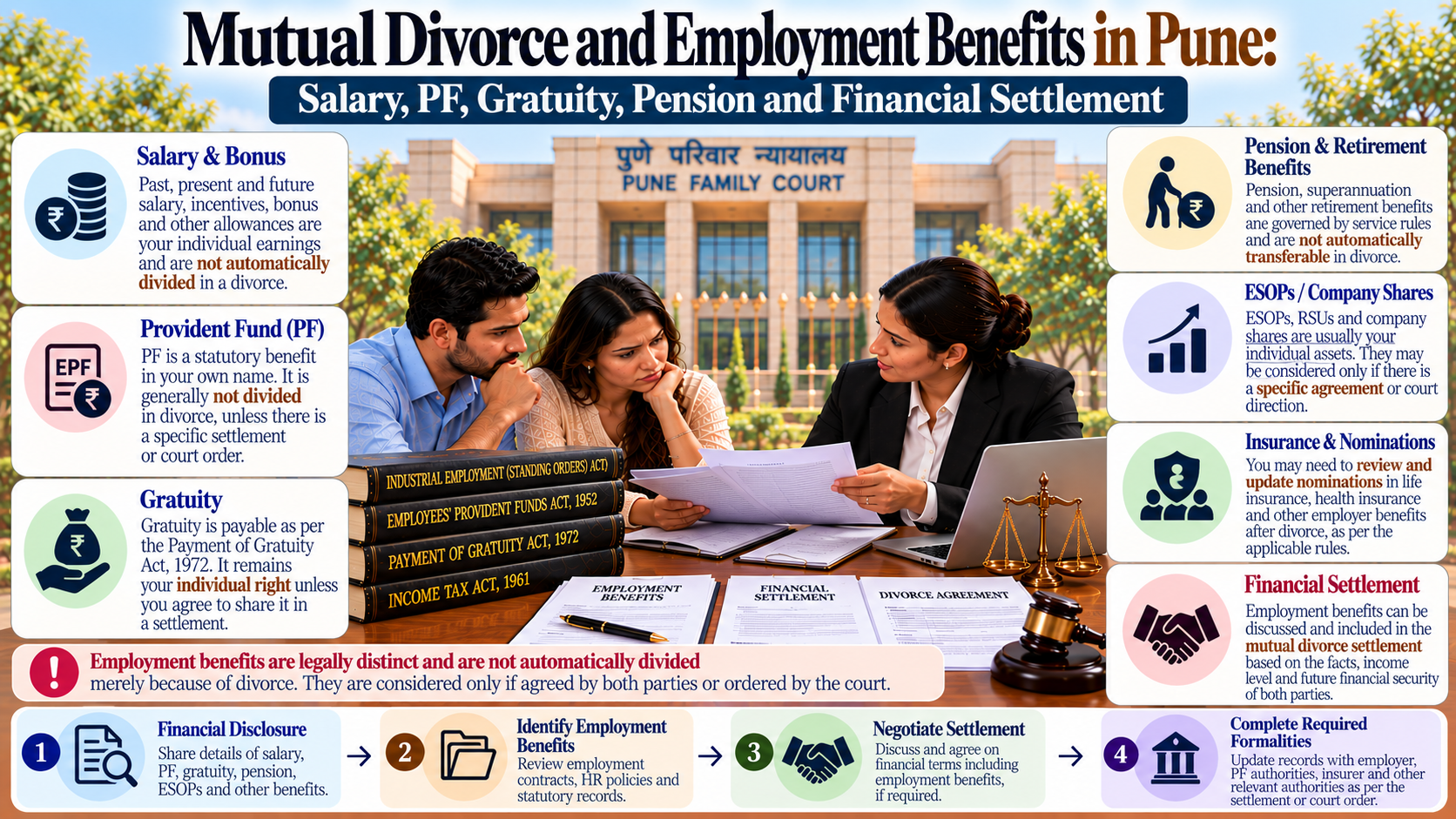
Employment-related benefits can become an important part of financial discussions during a mutual divorce. A spouse may receive salary, bonus, provident-fund benefits, gratuity, pension, insurance benefits, stock options, leave encashment, retirement benefits or other employment-linked payments. These items should not all be treated as ordinary matrimonial property. Their legal character, ownership, vesting, withdrawal rules, tax treatment and relevance to maintenance or settlement can differ.
A Section 13B mutual divorce petition primarily concerns dissolution of the marriage by mutual consent. The parties may simultaneously negotiate a comprehensive financial settlement. If employment and retirement benefits are relevant to that settlement, the agreement should identify them accurately and distinguish between present income, future earning capacity, vested financial interests and benefits payable under a separate employment or statutory scheme.
Does mutual divorce automatically divide salary or employment benefits?
No. A divorce decree does not automatically divide a spouse’s monthly salary, employer-provided benefits or every retirement entitlement. Parties may take financial circumstances into account while negotiating maintenance or a full-and-final settlement, but the legal treatment of each benefit depends upon its nature and the applicable law.
Salary already earned, unpaid salary, bonus, provident-fund balance, gratuity entitlement, pension benefits, stock options and insurance proceeds can involve different legal and contractual rules. A settlement should therefore avoid using one broad phrase such as “all employment benefits” without identifying what is intended to be covered.
Why salary matters in a mutual divorce settlement
Current salary may be relevant to maintenance, alimony, child support and the parties’ assessment of financial circumstances. The relevant figure may not always be the gross salary shown on a payslip. Deductions, taxes, bonuses, reimbursements, employer contributions, loans and other components may affect the practical financial position.
Parties may use salary records, income-tax returns, bank statements, employment contracts and other reliable documents to establish the financial position. The settlement should state the agreed financial obligation rather than assuming that a particular salary percentage automatically determines alimony.
What if one spouse receives an annual bonus?
A bonus may be discretionary, performance-linked, contractual or already earned but payable later. If the bonus is relevant to the financial settlement, the parties should identify the applicable financial year and whether the settlement covers a bonus already accrued, a future bonus or both.
A settlement can also specify whether any bonus received after the settlement date is retained by the earning spouse or included in a particular financial adjustment. Clear drafting can avoid later disagreement over whether a payment was part of the settlement.
What about unpaid salary or employment dues?
Unpaid salary, leave encashment, reimbursement claims and other employment dues may constitute amounts payable to the employee. If such amounts are relevant to a settlement, they should be separately identified and not confused with retirement benefits or employer assets.
Provident fund and mutual divorce
Provident-fund interests require careful treatment because the balance may arise from employee contributions, employer contributions and applicable statutory rules. A settlement can take a spouse’s overall financial position into account, but parties should not assume that a divorce petition itself authorises withdrawal or transfer of a provident-fund balance contrary to the governing scheme.
If the parties agree that the value of a provident-fund interest is considered in a full-and-final financial settlement, the settlement should specify whether it is only a valuation factor or whether any actual transfer, withdrawal or other action is intended.
Can one spouse claim the other spouse’s PF balance?
There is no universal rule that a spouse automatically becomes the owner of the other spouse’s provident-fund balance merely because the parties are married or subsequently divorced. The relevance of the balance may arise in financial-disclosure and settlement discussions, but the statutory scheme governing the account remains important.
If a settlement is intended to resolve all financial claims between spouses, the parties should identify the treatment of the PF interest clearly and ensure that the agreed mechanism is legally and practically implementable.
Gratuity and mutual divorce
Gratuity is an employment-related statutory or contractual benefit whose availability and amount depend upon the governing law and employment circumstances. A future gratuity entitlement should not automatically be treated as presently payable cash.
If gratuity is relevant to settlement negotiations, the parties should identify whether the discussion concerns an amount already received, an accrued entitlement, or a future benefit. The settlement should not require an employee to transfer an employment benefit in a manner inconsistent with the governing scheme.
Pension and retirement benefits
Pension arrangements can involve statutory schemes, employer pension schemes, government service rules or other contractual arrangements. A pension may be payable periodically in the future rather than existing as a presently transferable asset.
The parties may consider retirement benefits when negotiating maintenance or a broader financial settlement, but the settlement should distinguish a financial claim between spouses from the underlying pension rights governed by the applicable service or pension rules.
What about government employees?
Government employment may involve service rules governing salary, pension, gratuity, provident fund, family pension and nominations. A matrimonial settlement should not assume that a private agreement between spouses automatically changes a nomination or entitlement governed by service rules.
Where a government employee is involved, the relevant service and pension rules should be examined before drafting provisions concerning retirement benefits or family-related entitlements.
Employee stock options and company shares
Employee stock options, restricted stock, shares and other equity-linked benefits can be particularly complex. Some interests may be vested while others may depend on continued employment, performance or future events. Transfer restrictions may also apply.
A settlement should distinguish vested shares from unvested or contingent benefits. If the parties agree on a monetary settlement based on equity compensation, the valuation date and treatment of future vesting should be stated clearly.
Insurance benefits and nominations
Employer-provided life insurance, group insurance, health insurance and personal insurance may have separate contractual terms and nomination provisions. A settlement should identify whether a particular policy or benefit is actually intended to be changed and whether the insurer or employer must be approached separately.
A settlement clause concerning an insurance policy does not necessarily itself change the insurer’s records. The parties should complete any required nomination or policy documentation through the appropriate process.
Leave encashment
Leave encashment may become payable when employment ends or under the applicable employment policy. If an amount has already accrued or is expected to be paid, it may be relevant to financial disclosure and settlement negotiations.
Notice pay and employment disputes
If a spouse is involved in an employment dispute concerning notice pay, bonus, salary arrears, variable pay or other employment dues, the matrimonial settlement should distinguish that employment dispute from the financial claims between spouses.
A spouse cannot ordinarily use a private matrimonial settlement to alter the contractual rights of an unrelated employer. If the settlement depends upon receipt of employment dues, the agreement should state the relevant contingency rather than treating the payment as guaranteed.
Business and professional income
Self-employed professionals may not have a conventional salary. Their financial position may involve professional receipts, drawings, retainers, consultancy income, business expenses and receivables. These should be assessed separately from employment benefits.
Financial disclosure before settlement
A comprehensive settlement is easier to draft when the parties have a clear financial schedule. Depending on the case, relevant documents may include salary slips, Form 16, income-tax returns, bank statements, PF statements, pension statements, gratuity information, bonus letters, ESOP statements, insurance records and loan statements.
Disclosure should remain proportionate to the issues being settled. Confidential employer information unrelated to the spouse’s financial position should not automatically be reproduced in a matrimonial settlement.
Can employment income affect permanent alimony?
Income and earning capacity can be relevant to maintenance and permanent-alimony discussions, but there is no universal mathematical formula that applies to every mutual divorce. The parties may negotiate an amount based on their financial circumstances, while a court dealing with contested maintenance applies the law applicable to the proceeding.
In a May 2026 Supreme Court decision, the Court considered factors including earning capacity, standard of living, duration of marriage, years of separation and the need for financial security while fixing a case-specific one-time permanent-alimony settlement. The decision illustrates the importance of financial circumstances but does not establish a fixed percentage of salary for every divorce.
Recent Supreme Court developments on financial settlements
Recent Supreme Court orders demonstrate that matrimonial settlements can contain detailed financial terms, including full-and-final alimony, stridhan, staged payments and treatment of other matrimonial claims. In May 2026, the Court recorded a settlement involving ₹80 lakh toward permanent alimony and an additional ₹10 lakh toward stridhan, with specified payment arrangements. This was a case-specific settlement and should not be treated as a benchmark for another family’s financial settlement.
In another May 2026 matter, the Court recorded a settlement under which ₹33 lakh was agreed as one-time maintenance and alimony, along with provisions concerning return of articles and resolution of matrimonial claims. Again, the amount resulted from the particular parties’ settlement and facts.
The Supreme Court has also continued to encourage appropriate consensual resolution of family disputes. Its September 2026 regional conference on ADR and adjudication included maintenance and alimony, division and partition of property, marriage and divorce, custody and related family-law issues. The development reflects continuing institutional attention to structured settlement, while the substantive legal requirements remain case-specific.
How should an employment-benefit settlement be drafted?
- Identify the employee’s present employer and employment status where relevant.
- Identify current salary only to the extent necessary for the settlement.
- Identify accrued salary, bonus or leave encashment separately.
- Identify provident-fund interests separately from bank balances.
- Identify gratuity as accrued or future, rather than assuming it is presently payable.
- Identify pension or retirement benefits according to the applicable scheme.
- Identify vested and unvested equity compensation separately.
- Identify insurance policies and whether any nomination change is intended.
- State the financial settlement amount and payment schedule clearly.
- State whether the settlement is intended to resolve past, present and future personal maintenance claims.
- Address child support separately from the spouses’ personal claims.
- Identify any employment dispute separately from matrimonial obligations.
Common mistakes
- Treating salary as a matrimonial asset that must automatically be divided.
- Assuming a spouse automatically owns half of the other spouse’s PF or pension.
- Treating future gratuity as immediately available cash.
- Ignoring unvested stock options and their conditions.
- Assuming a divorce settlement automatically changes insurance nominations.
- Treating gross salary as identical to disposable income.
- Failing to distinguish employment dues from maintenance claims.
- Using a fixed percentage of salary as though it were a universal alimony rule.
- Failing to document payment of a full-and-final settlement.
- Ignoring child-related financial arrangements.
Pune practical checklist
Before signing a mutual divorce settlement involving employment benefits in Pune, the parties should prepare a financial schedule showing current income, accrued employment dues, retirement interests, equity compensation, insurance arrangements, liabilities and the proposed settlement amount.
The schedule should then distinguish benefits that can be paid or transferred now from benefits that are future or scheme-dependent. The settlement should also identify any action that must be taken with an employer, insurer, pension authority, fund administrator or other third party.
Frequently Asked Questions
1. Does mutual divorce automatically divide salary?
No. Salary is income, and its relevance to a settlement or maintenance claim depends on the applicable law and the parties’ agreement.
2. Can one spouse claim the other’s PF balance?
There is no universal automatic ownership transfer merely because of marriage or divorce. The governing PF scheme and the terms of any settlement must be considered.
3. Is gratuity divided during mutual divorce?
Gratuity should be examined according to the applicable employment law and whether the entitlement has accrued. A settlement may take it into account without treating it as immediately transferable cash.
4. Can pension be included in a settlement?
Pension rights may be relevant to financial negotiations, but the underlying entitlement is governed by the applicable pension or service scheme.
5. Does a spouse automatically get half of the other spouse’s retirement savings?
There is no universal rule providing an automatic fifty-percent share in every retirement benefit. The applicable law, scheme and settlement terms matter.
6. Can a bonus be included in mutual divorce settlement?
The parties may agree on treatment of an accrued or expected bonus, but the settlement should identify the relevant period and conditions.
7. What about ESOPs in a divorce settlement?
Vested and unvested equity interests should be distinguished, and the applicable employment and corporate restrictions should be considered.
8. Can an insurance nomination be changed through a divorce settlement?
A settlement may record an agreed intention, but the policyholder must follow the insurer’s applicable procedure for any effective nomination change.
9. Does salary determine alimony?
Salary can be relevant, but there is no universal fixed formula that determines alimony in every matrimonial matter.
10. What if the spouse is self-employed?
Financial assessment may require examination of professional receipts, business income, expenses, drawings and other reliable records rather than a conventional payslip.
11. Can leave encashment be included in settlement?
If accrued or payable, it can be identified as part of the financial disclosure and settlement, subject to the employment terms.
12. What if the spouse has an employment dispute?
The employment dispute should be identified separately from matrimonial claims and should not be assumed to be resolved merely because the spouses settle their divorce.
13. Can a divorce settlement bind the employer?
A private settlement between spouses generally does not alter an employer’s contractual or statutory obligations without the employer’s involvement where required.
14. Can PF or pension be withdrawn immediately for settlement?
Withdrawal or transfer depends on the applicable statutory or contractual scheme. A divorce settlement does not itself override those rules.
15. What financial documents should be exchanged?
Depending on the case, salary slips, tax returns, bank statements, PF records, pension information, bonus records, equity statements and insurance records may be relevant.
16. Can a full-and-final settlement cover future maintenance?
Parties may agree upon the scope of a financial settlement, subject to applicable law and the validity and enforceability of the terms.
17. Is child support included in the spouses’ full-and-final settlement?
Child-related financial obligations should be addressed separately because the child’s interests are distinct from the spouses’ personal claims.
18. Can future salary increases be included in the settlement?
The parties can define the financial claims being settled and the relevant cut-off date, but the enforceability of any future-income clause depends on its wording and applicable law.
19. What if retirement benefits are payable many years later?
The settlement should distinguish a future scheme-based entitlement from a presently available asset and specify whether it is merely considered in the financial settlement.
20. What is the key point about employment benefits in mutual divorce?
Salary, PF, gratuity, pension, bonus, insurance and equity compensation are not legally identical. Each should be identified according to its actual nature before a comprehensive settlement is signed.
Important Disclaimer
Important Disclaimer
This article is provided solely for general legal information and public awareness. It is not legal advice, legal opinion, or a legal solution to any specific facts or circumstances. Laws and their interpretation may change, and the application of law depends upon the facts of each individual matter. Readers should not rely upon this article as a substitute for obtaining appropriate legal advice concerning their specific circumstances. Nothing contained in this article creates, establishes or constitutes an advocate-client relationship between the reader and Trident Legal Services, Advocate Nikhil Rathod, or any other person associated with the publication.
Related Mutual Divorce Articles
Related Mutual Divorce Articles
Post Views: 399