
Divorce Law in India: Grounds, Procedure, Maintenance…
Important Disclaimer This article is provided solely for general legal information and public awareness. It…
EXCELLENT Based on 66 reviews
 Posted on Google
 Nabeel AkhtarFacing a criminal case can be stressful, but Advocate Nikhil Rathod made the entire process manageable. His strategic approach and strong representation gave me great relief.Posted on Google
 Srinath KarliAn experienced and sharp lawyer. Truly fast and great precise advocacy services offered. Highly recommended! Thankyou.Posted on Google
 SHIVA GAIKWAD
Trustindex verifies that the original source of the review is Google.
Good experience 👍👍👍👍Posted on Google Mangesh LawandeBest advocate for getting justice in Pune he is a very kind by nature 😊✨💫
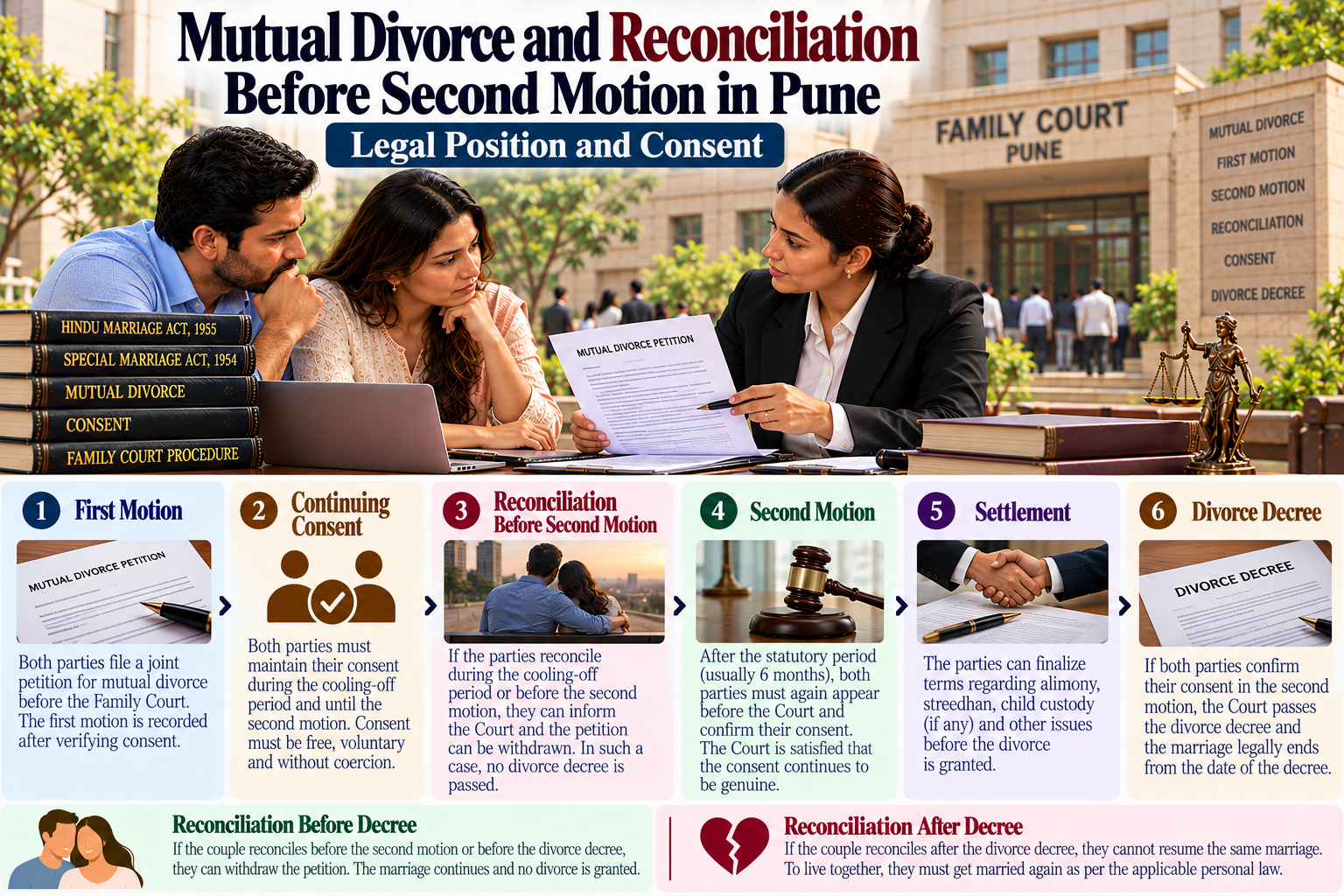
Mutual divorce is based on continuing consent. This becomes particularly important when spouses have filed the first motion but later reconsider reconciliation before the second motion. A spouse may ask whether the couple can resume their marriage, whether the divorce petition can simply remain pending, whether consent can be withdrawn, and what happens to a settlement already signed.
Under Section 13B of the Hindu Marriage Act, 1955, the mutual-divorce process involves a joint petition followed by a later motion of both parties. The statutory text itself contemplates that the petition may be withdrawn before the later stage. The Supreme Court has also reiterated that mutual consent must continue until the divorce decree is passed.
Yes. Filing a mutual-consent divorce petition does not itself dissolve the marriage. The marriage continues until a competent court passes a decree of divorce.
If the spouses genuinely decide to resume their marital relationship, they can communicate that position to the court and take appropriate procedural steps concerning the pending petition. The precise step depends on the stage of the case and the orders already passed.
In a Section 13B proceeding under the Hindu Marriage Act, the first motion is the initial joint stage at which the spouses state that they have been living separately, cannot live together and mutually agree that the marriage should be dissolved. Section 13B(2) then provides for the later motion between six and eighteen months from presentation of the petition, subject to the statutory conditions.
The statutory language expressly refers to the petition not being withdrawn in the meantime. This means that the period between the first motion and second motion is not merely an administrative waiting period. The continuing consent of both spouses remains legally significant.
A spouse can indicate that he or she no longer consents to the mutual divorce before the decree is passed. The Supreme Court has reiterated that consent under Section 13B must continue until the decree of divorce is granted. In an April 2026 Supreme Court judgment, the Court referred to the principle that mutual consent must remain valid and subsisting when the matter is heard for the decree.
Accordingly, a first-motion order should not ordinarily be treated as an irreversible decree of divorce. The parties’ consent at the later stage remains material.
If both spouses genuinely want to resume the marriage, they can inform the Family Court and take the appropriate procedural step regarding the pending mutual-divorce petition. Depending on the case, this may involve withdrawal of the petition or recording that the parties no longer seek a decree by mutual consent.
The spouses should avoid leaving the matter unattended merely because they have decided privately to reconcile. The pending court proceeding should be dealt with formally so that the court record accurately reflects the parties’ present position.
Not necessarily. A divorce settlement and reconciliation are legally distinct issues. If the spouses signed a settlement dealing with alimony, property, jewellery, child expenses, withdrawal of cases or other rights, the effect of that document depends upon its wording, execution, performance and the circumstances in which it was entered.
If reconciliation has occurred and the parties intend to restore their relationship, they should review any settlement already signed before acting on it. Payments, transfers or relinquishments already completed may require separate consideration.
If money has already been paid pursuant to a settlement before the divorce decree, the parties should not assume that the payment automatically becomes irrelevant after reconciliation. The settlement document, payment records and any court order recording the arrangement should be examined.
Where the parties mutually agree to reverse or adjust the financial arrangement, the terms should be documented clearly. If there is a dispute about repayment or restoration of property, it may require a separate legal analysis.
Return of jewellery or personal articles under a settlement should be documented through an inventory, acknowledgment or other reliable record. Reconciliation does not by itself create an automatic rule that every item must be returned to its previous holder or that every transfer is reversed.
The parties should identify what was actually transferred, the date of transfer and the legal basis on which it was transferred before deciding how to proceed after reconciliation.
A settlement recorded in a court proceeding requires particular care. A court record is different from an informal conversation between spouses. The effect of the settlement depends on the order passed, the terms recorded and whether any part of the settlement has already been performed.
The Supreme Court’s recent matrimonial matters demonstrate that settlements can contain detailed financial and property obligations and that the Court may act on settlements in appropriate proceedings. A case-specific settlement should not, however, be treated as establishing a universal rule for every Family Court proceeding.
Yes. The six-month period is a stage within the statutory mutual-divorce process and does not prevent the spouses from reconsidering their decision. The parties may reconcile during this period and communicate their changed position to the court.
The six-month period should also not be confused with the one-year separation requirement for presenting a mutual-consent petition. These are separate statutory requirements serving different stages of the process.
Reconciliation should be genuine before the parties take steps to abandon a divorce proceeding. If the spouses are uncertain, they may consider counselling or mediation rather than immediately taking irreversible financial or procedural steps.
A reconciliation attempt can also involve practical arrangements concerning residence, finances, communication, children and pending disputes. Any decision should be documented carefully where substantial rights are involved.
Mutual-consent divorce depends upon mutual consent. A court cannot simply substitute its own agreement for the parties’ consent in an ordinary Section 13B proceeding. If one spouse no longer maintains the necessary consent, the statutory basis for granting a mutual-consent decree may no longer exist.
This principle is different from the Supreme Court’s exceptional constitutional jurisdiction under Article 142. The Supreme Court has, in appropriate cases, exercised Article 142 powers to dissolve marriages and give effect to settlements. Such exceptional Supreme Court jurisdiction should not be understood as conferring an unrestricted Article 142-type power on a Family Court.
If one spouse wants to reconcile while the other continues to seek divorce, the mutual-consent proceeding may not result in a decree because mutual consent is no longer continuing. The spouse seeking divorce would then need to consider whether an independent legal remedy is available under the applicable matrimonial law.
A mutual-consent petition should not be converted informally into a contested divorce without complying with the applicable procedural requirements.
Where children are involved, reconciliation can raise practical issues about residence, education, medical care and parenting arrangements. If earlier settlement terms were made for the child, those terms should be reviewed in light of the changed family circumstances.
The child’s welfare remains an important consideration. Parents should avoid treating child-related arrangements merely as financial bargaining terms.
Reconciliation does not automatically terminate every pending criminal, domestic-violence, maintenance or civil proceeding. Each proceeding has its own legal basis and procedural mechanism.
If the spouses decide to resume their relationship, they should identify every pending proceeding and determine what procedural action, if any, is legally required. Simply stating in a private agreement that “all cases are withdrawn” may not be sufficient for every type of proceeding.
Yes. Where the parties are uncertain about reconciliation, mediation can provide a structured setting to discuss whether the marriage can continue and what changes would be required. Mediation can also address financial, property, parenting and communication issues without itself dissolving the marriage.
If the parties decide to reconcile, the court proceeding should still be addressed through the appropriate procedural route. If they decide to proceed with divorce, the settlement should be reviewed to ensure that it accurately reflects their final agreement.
A significant Supreme Court development in 2026 reinforces the importance of continuing consent in mutual-consent divorce. In an April 2026 judgment, the Court considered a dispute where one spouse had resiled from a settlement before the second motion. The judgment records the principle that mutual consent must continue until the divorce decree is passed. The case also involved disputes concerning the settlement and financial/property claims, demonstrating why the status of consent and the status of settlement should be analysed separately.
In another Supreme Court matter decided in May 2026, the Court recorded a settlement, waived the six-month cooling period in the circumstances of that case and granted a mutual-consent divorce under Article 142. The order illustrates that waiver and constitutional relief can depend heavily on the particular facts and procedural posture.
| Issue | If spouses reconcile | If spouses continue divorce |
|---|---|---|
| Marriage | Continues unless already dissolved by decree | Continues until the divorce decree |
| Mutual consent | Parties may no longer seek divorce by consent | Consent must continue through the required stage |
| Settlement | Should be reviewed for its effect after reconciliation | Should reflect final agreed terms |
| Second motion | May no longer be pursued as mutual divorce | Both parties must satisfy the statutory requirements |
| Pending cases | Need separate procedural consideration | Settlement may address them subject to applicable law |
Yes. Filing the petition does not itself dissolve the marriage. The parties can reconsider their decision before the divorce decree.
Mutual consent must continue until the decree. A spouse who no longer consents can communicate that position to the court.
No. The first motion is part of the mutual-divorce process. The marriage is dissolved only when the competent court passes the divorce decree.
The parties may reconsider their decision during the statutory period. If they reconcile, the pending proceeding should be dealt with formally.
No automatic rule should be assumed. The wording of the settlement, court orders and actions already completed must be examined.
The effect depends on the settlement and payment records. Repayment or adjustment should be documented rather than assumed.
The parties should record what was returned and consider separately whether any further transfer or restoration is legally required.
Mutual consent must continue for a mutual-consent decree. The court cannot ordinarily substitute its own consent for a party’s continuing consent under Section 13B.
The mutual-consent divorce may not proceed as a mutual petition if the other spouse no longer seeks reconciliation and continues to seek divorce.
No. The legal effect depends on the nature of each proceeding and the procedure available for its withdrawal, compounding or quashing.
Yes. Mediation may help the parties discuss whether reconciliation is workable and resolve related financial or parenting issues.
The parties may need to reassess their legal options. A previous mutual-divorce petition should not be assumed to remain available in exactly the same procedural form after reconciliation.
It can. Earlier arrangements should be reviewed in light of the child’s current circumstances and welfare.
Potential remedies depend on the settlement, the circumstances of execution, court orders and whether the settlement has already been acted upon.
Once the divorce decree has been passed, the marriage has been legally dissolved. Reconciliation after that point is legally different from reconciliation before the decree.
Reconciliation after the first motion is legally possible because a mutual-consent petition does not itself dissolve the marriage. The critical point is that mutual consent must continue until the divorce decree is passed. The Supreme Court’s 2026 jurisprudence reinforces this continuing-consent principle.
Where spouses genuinely reconcile, they should address the pending court proceeding formally and review any settlement, payments, property transfers and pending cases. Where they decide to continue with divorce, they should confirm that consent remains voluntary and subsisting and that the settlement accurately reflects their final agreement.
This article is provided solely for general legal information and public awareness. It is not legal advice, legal opinion, or a legal solution to any specific facts or circumstances. Laws and their interpretation may change, and the application of law depends upon the facts of each individual matter. Readers should not rely upon this article as a substitute for obtaining appropriate legal advice concerning their specific circumstances. Nothing contained in this article creates, establishes or constitutes an advocate-client relationship between the reader and Trident Legal Services, Advocate Nikhil Rathod, or any other person associated with the publication.
+91 820 890 9423
desk@tridentlegal.in
Flat No. 302, Kalunkhe Niwas, Khopade Nagar, Gujaewadi, Katraj, Pune - 411041


I was really impressed with Trident Legal and Advocate Nikhil Rathod. Even though they just started,
Trident Legal and Advocate Nikhil Rathod are really good at what they do. Even though they
I had a great experience with Trident Legal and Advocate Nikhil Rathod. Even though they are
Trident Legal, with Advocate Nikhil Rathod, is like a rising star in the legal world. I
I was lucky to work with Trident Legal and Advocate Nikhil Rathod. Even though they just
Trident Legal and Advocate Nikhil Rathod are really amazing! They helped me with legal stuff and
Trident Legal and Advocate Nikhil Rathod are like superheroes! They are really good at legal stuff
I wasn’t sure about Trident Legal because they are new, but they surprised me! Advocate Nikhil
I had the honor of working with Trident Legal and Advocate Nikhil Rathod. They were really
Trident Legal, led by Advocate Nikhil Rathod, is like a superhero in the legal world. Even

Important Disclaimer This article is provided solely for general legal information and public awareness. It…
When spouses decide to seek divorce by mutual consent, arrangements for their children often require…
When a marriage involves an Indian citizen, an Overseas Citizen of India (OCI) cardholder or…
Indian couples living or working abroad sometimes obtain a divorce decree from a foreign court…
When parents agree to a mutual divorce, arrangements for their minor child may extend beyond…
Spouses may hold assets in more than one country. A couple filing for mutual divorce…
