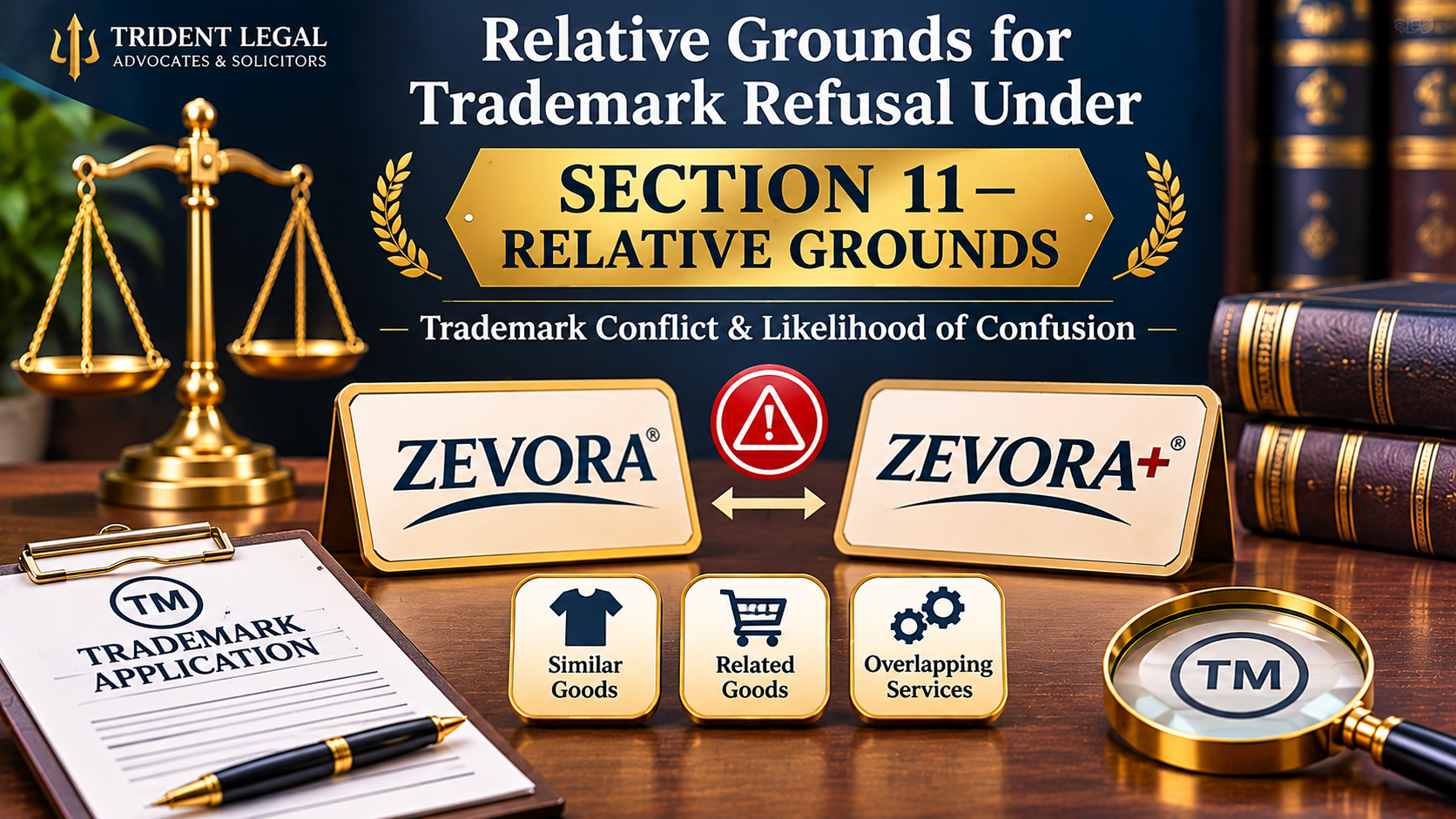
Trademark applications may be refused when an earlier trademark or other legally protected right creates a conflict with the proposed mark. These are called relative grounds for refusal. Unlike absolute grounds under Section 9, which assess the mark’s inherent registrability, Section 11 focuses primarily on earlier marks, third-party rights and the likelihood of confusion or other statutory conflict.
1. What are relative grounds for trademark refusal?
Relative grounds arise from the relationship between the applied-for mark and earlier rights. The Registry may cite earlier marks in an examination report, and an earlier proprietor may also raise objections through opposition proceedings. A conflict assessment considers the marks, the goods/services, the relevant consumers and the overall circumstances—not just whether the words are identical.
2. Section 11(1): Earlier mark and likelihood of confusion
Section 11(1) addresses cases involving identity of marks and similarity of goods/services, or similarity of marks and identity or similarity of goods/services, where there is a likelihood of confusion among the public, including likelihood of association with the earlier mark. The provision is subject to Section 12, which addresses honest concurrent use and other special circumstances.
For example, a later application for a mark that closely resembles an earlier mark for the same or related products may face an objection if consumers could believe the products come from the same business or economically connected undertakings. The example is illustrative; confusion depends on the facts.
3. How similarity between marks is assessed
Comparison is not limited to a side-by-side visual inspection. Depending on the marks, factors may include their visual appearance, sound, meaning, dominant or distinctive elements, overall impression and the way consumers encounter them. Imperfect recollection and ordinary purchasing conditions may be relevant. A minor spelling or design change does not automatically eliminate similarity.
For device or composite marks, the analysis may consider the mark as a whole while also examining distinctive or dominant elements where appropriate. The assessment must not artificially dissect the marks or ignore material differences.
4. Similarity or identity of goods and services
Goods or services may be considered identical, similar, complementary, competing or related in commercial context. Classification in the same Nice class can be relevant but is not conclusive; goods in different classes may still be commercially related, and goods in the same class may not necessarily be similar. The specification, purpose, consumers, trade channels, nature and market relationship should be examined.
5. Section 11(2): Well-known marks and dissimilar goods/services
Section 11(2) may prevent registration for goods/services that are not similar to those covered by an earlier mark where the earlier mark is well-known in India and use of the later mark without due cause would take unfair advantage of, or be detrimental to, its distinctive character or reputation. This protection can extend beyond the earlier mark’s ordinary goods/services field, but the statutory conditions must be established.
Well-known status should not be assumed simply because a mark is famous internationally. Relevant evidence may include recognition in the relevant public, duration and geographical extent of use and promotion, registrations, enforcement history and other statutory factors.
6. Section 11(3): Earlier unregistered rights and copyright
Section 11(3) addresses cases where use of the later mark in India may be prevented under another law, including passing-off protection for an unregistered trademark used in trade or copyright law. Thus, an earlier mark may have legal significance even if it is not registered in the same way as a registered trademark conflict under Section 11(1).
Businesses should assess unregistered prior users, goodwill, the actual mark used, the relevant goods/services, ownership and evidence. Copyright may also be relevant where a logo or artistic work is copied, subject to the applicable legal requirements.
7. Consent and Section 11(4)
Section 11(4) provides that the section does not prevent registration where the proprietor of the earlier trademark or other earlier right consents, and the Registrar may register the later mark under special circumstances as contemplated by Section 12. Consent is not a guaranteed outcome; the wording, scope, parties, rights and special circumstances should be reviewed carefully.
8. Section 11(5): Opposition grounds in certain cases
Section 11(5) states that registration shall not be refused on the grounds specified in Section 11(2) and (3) unless an objection on one or more of those grounds is raised in opposition proceedings by the proprietor of the earlier trademark. Applicants should distinguish these provisions from Section 11(1), and read the statutory text carefully when responding to an examination report or opposition.
9. Practical response to a Section 11 examination objection
- Identify every cited earlier mark and its application/registration details.
- Compare the marks visually, phonetically and conceptually, including their overall impression.
- Review the precise goods/services specifications and their commercial relationship.
- Assess the relevant consumer, purchasing conditions, trade channels and potential association.
- Check status, dates, ownership and scope of the cited mark.
- Use factual distinctions and legal authorities where relevant; avoid conclusory statements that the marks are “different.”
- Consider narrowing the specification only where commercially appropriate and legally permissible.
- Monitor response and hearing deadlines and preserve filing confirmation.
10. Pre-filing clearance checklist
- Search exact, phonetic, visual and conceptual variants of the proposed mark.
- Search relevant classes and commercially related goods/services.
- Check earlier applications, registrations and known unregistered market use.
- Review the mark’s dominant and distinctive features and overall impression.
- Investigate potential well-known-mark risks, even outside the immediate class.
- Assess domain names, business names and copyright issues as part of broader clearance where relevant.
- Document the search and identify residual risks before launch.
Frequently Asked Questions
1. What is Section 11 of the Trade Marks Act?
Section 11 provides relative grounds for refusal, addressing conflicts with earlier marks and other rights, including likelihood of confusion, well-known marks, passing-off and copyright issues in specified circumstances.
2. What is the difference between Section 9 and Section 11?
Section 9 assesses absolute registrability of the mark itself, such as distinctiveness and descriptiveness. Section 11 examines conflicts with earlier marks and other protected rights.
3. Can a trademark be refused even if it is not identical to an earlier mark?
Yes. Similarity of marks combined with identity or similarity of goods/services can create a likelihood of confusion or association under Section 11(1).
4. Are trademarks in different classes always safe from conflict?
No. Different classes do not automatically mean the goods/services are unrelated. Commercial relationship and the statutory tests matter.
5. Can a well-known trademark block registration in another class?
Section 11(2) can apply to dissimilar goods/services where the statutory requirements regarding well-known status, unfair advantage or detriment and lack of due cause are met.
6. Can an unregistered trademark be used to object?
Section 11(3) recognizes certain earlier rights protected by passing-off law, including unregistered marks used in trade, subject to the legal requirements and evidence.
7. Does a consent letter guarantee registration?
No. Consent is relevant under Section 11(4) read with Section 12, but registration remains subject to the Registrar’s consideration and applicable law.
8. What evidence is relevant to likelihood of confusion?
Evidence and analysis may address the marks, goods/services, consumers, trade channels, purchasing conditions, earlier rights, reputation and actual confusion where available.
9. What should I do if Section 11 is cited in an examination report?
Review the cited marks and specifications, develop a reasoned comparison, support relevant distinctions with evidence, and respond within the prescribed timeline or attend the hearing if required.
10. Is a trademark search a guarantee against objections?
No. Searches reduce risk but may not identify every relevant earlier right or future challenge. A clearance opinion is a risk assessment, not a guarantee.
Official reference
Trade Marks Act, 1999 — Section 11, IP India
Disclaimer
This article is for general informational purposes only and is not legal advice. Relative-ground analysis depends on the marks, goods/services, relevant consumers, evidence and statutory provisions. Reading this article or contacting the website does not create an advocate-client relationship.
Post Views: 63