

Mutual Divorce and Bank Accounts, Investments and…
Mutual divorce and bank accounts, investments and financial assets in Pune: understand joint accounts, fixed…
EXCELLENT Based on 66 reviews
 Posted on Google
 Nabeel AkhtarFacing a criminal case can be stressful, but Advocate Nikhil Rathod made the entire process manageable. His strategic approach and strong representation gave me great relief.Posted on Google
 Srinath KarliAn experienced and sharp lawyer. Truly fast and great precise advocacy services offered. Highly recommended! Thankyou.Posted on Google
 SHIVA GAIKWAD
Trustindex verifies that the original source of the review is Google.
Good experience 👍👍👍👍Posted on Google Mangesh LawandeBest advocate for getting justice in Pune he is a very kind by nature 😊✨💫

Mediation can play an important role when spouses are considering a mutual consent divorce in Pune. It provides a structured setting in which the parties can discuss issues such as alimony, child custody, maintenance, property, jewellery, financial liabilities and pending proceedings before finalizing the terms of their mutual divorce.
Mediation and mutual consent divorce are related but distinct processes. Mediation helps the parties negotiate and record an agreed settlement. A decree of divorce under Section 13B of the Hindu Marriage Act, 1955 is a judicial act based on the statutory requirements for mutual consent divorce. A mediation settlement does not, by itself, dissolve the marriage.
Mediation is a consensual dispute-resolution process in which a neutral mediator assists the parties in discussing their disputes and exploring settlement. The mediator does not ordinarily decide the dispute like a judge. The parties retain control over whether they agree to particular terms.
In a matrimonial dispute, mediation may address both the issues directly connected with the marriage and practical arrangements required to separate the parties, subject to the law governing the particular claim. The purpose is to help the parties identify areas of agreement and reduce unresolved issues before the matter proceeds further.
No. A mediated settlement is not itself a divorce decree. If the parties seek divorce by mutual consent under Section 13B of the Hindu Marriage Act, they must satisfy the statutory requirements and the competent court must pass the appropriate decree.
The distinction is important because parties sometimes sign a settlement believing that their marriage has already legally ended. Until the competent court grants the divorce decree, the settlement and the matrimonial status of the parties must be treated as separate legal questions.
Mediation may be useful where the spouses agree in principle that the marriage should end but have unresolved questions about:
Matrimonial disputes are commonly considered for settlement through mediation and other alternative dispute-resolution mechanisms. The Supreme Court’s Family Court Committee has continued to emphasize ADR in family disputes. In September 2026, the Supreme Court announced an Eastern Zone Regional Conference specifically titled “ADR Vs. Adjudication in Family Disputes: Challenges and Way Forward”, covering marriage, divorce, child custody, maintenance, alimony and property division among other issues. The conference focused on appropriate use of ADR alongside adjudication.
The existence of a mediation process does not remove the court’s role. Where the parties reach settlement, the settlement may then be placed before the appropriate court for consideration and further orders according to the nature of the proceedings.
The Mediation Act, 2023 provides a statutory framework for mediation in India. Section 22 contains confidentiality provisions concerning mediation communications, while Section 24 addresses termination of mediation. Section 27 provides that a mediated settlement agreement signed by the parties and authenticated by the mediator is final and binding on the parties and may be enforced in accordance with the Code of Civil Procedure, subject to the Act.
Section 28 provides limited statutory grounds for challenging a mediated settlement agreement, including fraud, corruption, impersonation and mediation of disputes or matters not fit for mediation under the Act. The application of the Mediation Act to a particular matrimonial proceeding must nevertheless be considered alongside the personal law, procedural law and nature of the relief being sought.
The Mediation Act, 2023 provides for confidentiality of specified mediation communications. Section 22 covers acknowledgments, opinions, suggestions, promises, proposals, apologies, admissions and other mediation communications, subject to statutory exceptions.
The Act also states that audio or video recording of mediation proceedings should not be made or maintained by parties, participants, mediators or mediation service providers, whether mediation is conducted physically or online, subject to the statutory framework.
The mediated settlement agreement itself is treated differently from ordinary mediation communications where disclosure is necessary for registration, enforcement or challenge. This distinction is important when drafting or later relying upon a settlement.
If the parties reach agreement, the terms should be reduced to a clear written settlement. The document should identify the parties, the disputes being resolved, the financial obligations, property arrangements, child-related terms, timelines for performance and the legal steps contemplated after settlement.
The settlement should not merely state that “all disputes are resolved.” A detailed schedule can be preferable where there are jewellery items, property documents, instalment payments, loans, bank accounts or pending proceedings.
Depending on the facts, a settlement may cover:
If the parties agree on alimony, the settlement should specify the exact amount, mode of payment, due dates and whether the payment is one-time or in instalments. If payment is conditional upon a particular procedural stage, that condition should also be stated clearly.
Supreme Court orders in 2026 illustrate this drafting approach. In one May 2026 matter, a mediated settlement included ₹80 lakh towards permanent alimony and ₹10 lakh towards stridhan, with specified payment arrangements. In another case involving a Delhi Mediation Centre settlement, the Supreme Court considered a settlement in which the husband had paid ₹89 lakh and handed over jewellery before the first motion, with the parties agreeing to seek mutual consent divorce. These are case-specific examples and do not establish any fixed amount or formula for matrimonial settlements.
Child-related issues should be considered separately from the spouses’ financial settlement. A mediation agreement may record the child’s residence, visitation, holidays, education, medical expenses, travel, communication and other practical arrangements, but the welfare of the child remains an important consideration.
A settlement should avoid treating the child as an object of exchange between the spouses. Financial arrangements for a child should be expressed as parental responsibilities and should be consistent with applicable law and the child’s welfare.
If the parties agree about a house, flat, land or other immovable property, the settlement should identify the property and explain the agreed action. If a separate sale deed, release deed, gift deed or other instrument is legally required, the settlement should not assume that the mediation document alone completes the transfer.
Home loans also require separate attention. An agreement between spouses does not automatically release a borrower or co-borrower from obligations owed to a bank or housing-finance institution.
If jewellery or stridhan is to be returned, an inventory should be prepared wherever practical. The settlement may specify the date, location and method of handover and should provide for acknowledgment of receipt.
The Supreme Court has continued to record settlements involving return of jewellery and other articles. In a May 2026 order, a mediated settlement included provisions for return of clothes and jewellery and recorded that the parties had resolved their matrimonial claims. The exact effect of such a settlement depends upon its terms and the court order in the particular case.
Matrimonial disputes sometimes involve FIRs, criminal complaints, domestic-violence proceedings, maintenance proceedings and civil cases. A mediation settlement may record the parties’ agreed steps concerning such proceedings, but the settlement does not automatically terminate every proceeding.
Where a proceeding requires an order from a competent court, the parties may have to approach that court separately. In some cases, particularly where criminal proceedings involve offences that cannot simply be withdrawn privately, the appropriate legal mechanism may include a petition before the High Court or another competent forum, depending on the case.
Online mediation is recognized within the statutory framework, subject to applicable procedures and safeguards. The Mediation Act, 2023 expressly contemplates online mediation. Supreme Court proceedings in matrimonial matters have also demonstrated the practical use of virtual participation in settlement-related proceedings.
In a Supreme Court order dated 27 May 2026, parties in a Section 13B matrimonial matter joined proceedings virtually and were identified by their respective counsel before the Court considered their settlement. This was a case-specific proceeding and should not be understood as establishing that every Family Court hearing or mediation can automatically be conducted virtually.
Mediation is consensual. A party may decide not to agree to a proposed settlement. Under Section 24 of the Mediation Act, 2023, mediation can terminate where a party communicates in writing that the party wishes to opt out, subject to the statutory framework.
A mediator cannot ordinarily impose a settlement merely because the parties have participated in discussions. If no agreement is reached, the dispute may continue before the appropriate court or through another legally available process.
Section 28 of the Mediation Act, 2023 provides statutory grounds for challenging a mediated settlement agreement, including fraud, corruption, impersonation and circumstances involving matters not fit for mediation under the Act. The appropriate forum and procedural route depend upon the circumstances and the nature of the settlement.
Separately, a matrimonial settlement may be examined by the court when it is placed before the court for recording or for consequential relief. Questions concerning voluntariness, compliance, statutory requirements and the scope of consent can therefore remain relevant.
| Issue | Mediation | Section 13B proceeding |
|---|---|---|
| Primary purpose | Negotiation and settlement | Judicial process for mutual consent divorce |
| Decision-maker | Parties negotiate with mediator assistance | Competent court determines whether statutory requirements are satisfied |
| Marriage dissolved? | No, by mediation alone | Yes, when the court grants the divorce decree |
| Settlement terms | Can record agreed financial, custody and other terms | May incorporate or rely upon agreed terms as appropriate |
| Consent | Settlement is voluntary | Mutual consent must continue as required by Section 13B |
Common mistakes include signing a settlement without identifying financial obligations, leaving payment dates vague, failing to address pending proceedings, overlooking third-party lender rights, mixing child support with spousal claims, failing to list jewellery, and assuming that the mediation settlement itself is the divorce decree.
Another mistake is using broad language such as “all disputes are permanently closed” without considering whether a particular proceeding requires an order from another court or whether an obligation remains to be performed.
The Supreme Court’s September 2026 regional conference on ADR and adjudication in family disputes expressly included marriage and divorce, custody and visitation, maintenance and alimony, and division and partition of property among the issues for discussion. The Court stated that the conference was intended to exchange experience and best practices for effective and timely resolution of family disputes while examining the appropriate role of ADR alongside adjudication.
This institutional development does not replace statutory divorce procedures. It reflects continuing judicial attention to the role of mediation and other consensual mechanisms in family disputes.
Mediation can help spouses convert a broad decision to separate into a detailed and workable settlement. In Pune mutual divorce matters, the parties should distinguish the mediation process, the settlement agreement and the Section 13B divorce proceedings, because each has a different legal function.
A carefully prepared settlement should identify financial payments, property, custody, maintenance, stridhan, pending proceedings and implementation steps. The parties should also understand which matters can be resolved by agreement and which require an order from a competent court or action by a third-party institution.
Mediation and mutual consent divorce are distinct processes. Whether mediation is required or directed in a particular case depends upon the court, the nature of the dispute and applicable procedure.
No. Mediation may result in a settlement, but the divorce decree under Section 13B must be granted through the competent judicial process.
Yes. Parties can negotiate alimony and record the agreed amount and payment schedule in the settlement, subject to applicable law and court procedure.
Parenting arrangements can be discussed and recorded, but the child’s welfare remains an important consideration and the competent court may examine the arrangement as required.
Under Section 27 of the Mediation Act, 2023, a mediated settlement agreement signed by the parties and authenticated by the mediator is final and binding and can be enforced subject to the Act.
Section 28 provides specific statutory grounds, including fraud, corruption, impersonation and mediation of matters not fit for mediation under the Act.
The Mediation Act, 2023 provides confidentiality protections for specified mediation communications, subject to statutory exceptions.
The statutory framework recognizes online mediation, subject to applicable procedure and safeguards.
Parties may discuss the consequences of a matrimonial settlement for pending proceedings, but a settlement does not automatically terminate every criminal proceeding. The appropriate court process may still be necessary.
Depending upon the case, it may cover alimony, custody, child expenses, property, loans, stridhan, bank accounts, pending proceedings, payment schedules and implementation obligations.
Mediation is consensual. Section 24 of the Mediation Act recognizes termination where a party communicates a wish to opt out, subject to the statutory framework.
No. A settlement and a divorce decree are separate legal events.
Yes. The settlement can record the agreed arrangement, but separate conveyancing, registration or institutional requirements may apply to implementation.
Where jewellery or stridhan is being returned or settled, a detailed inventory can reduce uncertainty and assist in proving compliance.
If no settlement is reached, the parties may continue the underlying proceedings or pursue another legally available dispute-resolution mechanism, depending upon the circumstances.
This article is provided solely for general legal information and public awareness. It is not legal advice, legal opinion, or a legal solution to any specific facts or circumstances. Laws and their interpretation may change, and the application of law depends upon the facts of each individual matter. Readers should not rely upon this article as a substitute for obtaining appropriate legal advice concerning their specific circumstances. Nothing contained in this article creates, establishes or constitutes an advocate-client relationship between the reader and Trident Legal Services, Advocate Nikhil Rathod, or any other person associated with the publication.
+91 820 890 9423
desk@tridentlegal.in
Flat No. 302, Kalunkhe Niwas, Khopade Nagar, Gujaewadi, Katraj, Pune - 411041


I was really impressed with Trident Legal and Advocate Nikhil Rathod. Even though they just started,
Trident Legal and Advocate Nikhil Rathod are really good at what they do. Even though they
I had a great experience with Trident Legal and Advocate Nikhil Rathod. Even though they are
Trident Legal, with Advocate Nikhil Rathod, is like a rising star in the legal world. I
I was lucky to work with Trident Legal and Advocate Nikhil Rathod. Even though they just
Trident Legal and Advocate Nikhil Rathod are really amazing! They helped me with legal stuff and
Trident Legal and Advocate Nikhil Rathod are like superheroes! They are really good at legal stuff
I wasn’t sure about Trident Legal because they are new, but they surprised me! Advocate Nikhil
I had the honor of working with Trident Legal and Advocate Nikhil Rathod. They were really
Trident Legal, led by Advocate Nikhil Rathod, is like a superhero in the legal world. Even

Mutual divorce and bank accounts, investments and financial assets in Pune: understand joint accounts, fixed…

Employment-related benefits can become an important part of financial discussions during a mutual divorce. A…

Business ownership can make a mutual divorce settlement more complex because a spouse’s financial position…
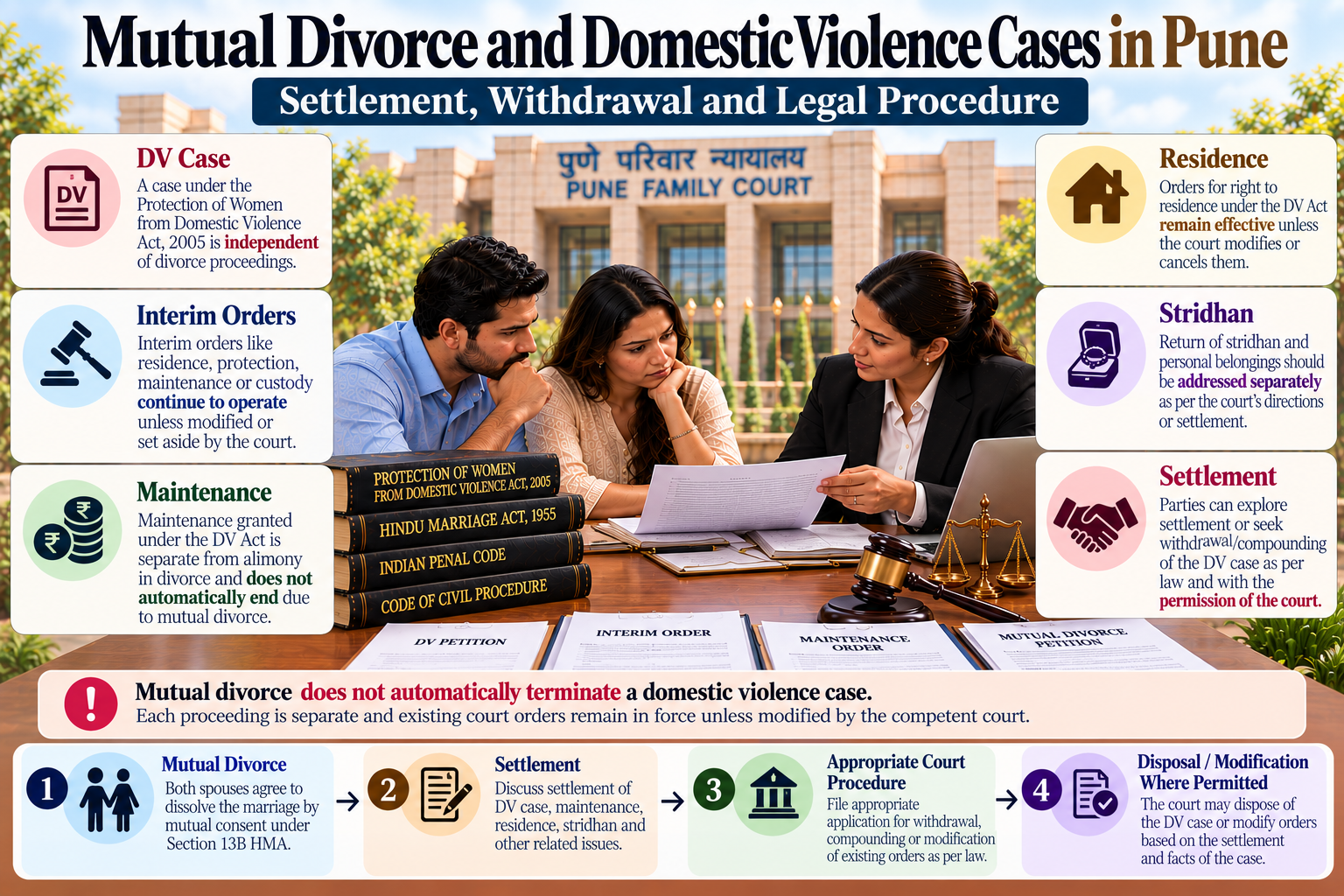
Mutual divorce and proceedings under the Protection of Women from Domestic Violence Act, 2005 may…
That. Mutual divorce and proceedings under the Protection of Women from Domestic Violence Act, 2005…

A home loan can make a mutual divorce settlement substantially more complicated because the marriage…
